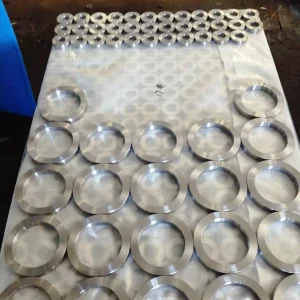
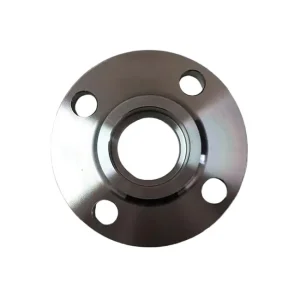
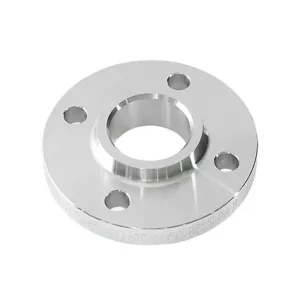
Explore our factory-direct forged piping components manufactured in Shanxi, China to ASME, EN, DIN, and JIS pressure standards.
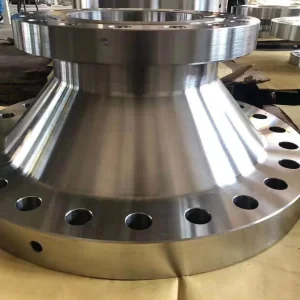
An engineering deep-dive into dimensional transitioning, fluid dynamics, and stress distribution in modern piping networks.
In complex process piping systems across petrochemical processing plants, power generation stations, and offshore platforms, controlling pipe diameter changes with minimal flow disruption is critical. Reducing flanges (commonly referred to as reducer flanges) represent a specialized category of forged pipe fittings engineered to connect pipes of different nominal bore sizes without requiring a standard pipe reducer fitting combined with a conventional flange. This dual-function capability—simultaneously providing line reduction and a bolted flanged connection—saves structural space, reduces weld seams, and minimizes overall assembly weight.
Designed with a symmetrical reduction center. Concentric reducing flanges maintain the center line of the pipe across both dimensions. Ideal for vertical piping runs or gas handling lines where fluid turbulence is minimized and uniform flow velocity is required.
Engineered with an offset centerline to keep either the top (Flat-on-Top) or bottom (Flat-on-Bottom) of the pipe level. Crucial for horizontal liquid lines to prevent vapor pockets or air binding before pump suction inlets.
Unlike fabricated pipe reducers welded to standard flanges, hot-forged reducing flanges feature an integrated wall transitions designed according to ASME B16.5 standards, offering superior resistance to pressure surges and thermal fatigue.
Information Gain Insight: Why Specify Reducing Flanges Over Pipe Reducer + Flange Assemblies?
Direct engineering data indicates that utilizing a forged reducing flange eliminates one circumferential weld joint per reduction point. In high-pressure applications (Class 600 to Class 2500), this eliminates a potential non-destructive examination (NDE) failure point, reduces installation labor costs by up to 35%, and shortens the overall face-to-face spatial layout by 40%.
| Parameter | ASME B16.5 Specification | EN 1092-1 Specification | YUXIN Factory Capability |
|---|---|---|---|
| Nominal Size Range | 1/2" to 24" (Standard), up to 60" (B16.47) | DN15 to DN1200 | 1/2" to 120" (DN15 to DN3000) |
| Pressure Rating | Class 150, 300, 400, 600, 900, 1500, 2500 | PN6, PN10, PN16, PN25, PN40, PN63, PN100 | Up to Class 2500 / PN400 hydrostatic testing |
| Facing Types | RF (Raised Face), FF (Flat Face), RTJ (Ring Type Joint) | Type A (Flat), Type B (Raised), Type C/D (Tongue/Groove) | CNC Machined (Serrated 125-250 µin AARH) |
| Material Grades | ASTM A105, A350 LF2, A182 F304/F316L/F11/F22 | P245GH, P280GH, 1.4404, 1.4301, 1.4571 | Full material heat traceability (EN 10204 3.1/3.2) |
Market dynamics, procurement strategies, and the economic reality of searching for "Discount" high-integrity forged components.
The global market for industrial forged flanges is undergoing a rapid transformation driven by massive investments in green hydrogen infrastructure, offshore oil exploration, liquid natural gas (LNG) export terminals, and municipal water modernization. Reducing flanges occupy a vital niche within this multi-billion dollar market. Buyers search for terms like "Discount Reducing Flanges Suppliers & Products" not to compromise on mechanical integrity, but to eliminate redundant middleman distribution markups in the international supply chain.
In B2B industrial procurement, "discount" pricing from leading Chinese manufacturing hubs like Dingxiang, Shanxi (China's Official "Hometown of Forging") stems from four distinct structural advantages rather than reduced material quality:
How advanced metallurgy, green forging, and digital quality control are shaping the future of pipe connection hardware.
By using computer-simulated die designs, near-net-shape forging minimizes scrap metal production by up to 30%, conserving raw alloy while optimizing internal grain flow lines along the critical stress flange neck.
Implementation of 100% automated Ultrasonic Testing (UT) and Magnetic Particle Inspection (MPI) ensures zero internal voids, inclusions, or micro-cracks before flanges reach the machining phase.
Transition from standard yellow rust oil to eco-friendly water-based epoxy resins, fluoropolymer (PTFE) coatings, and hot-dip galvanizing engineered for 30-year maintenance-free service in marine environments.
As industrial pipelines face higher pressures, lower operating temperatures (cryogenic LNG), and sour hydrogen-sulfide environments (NACE MR0175/ISO 15156), YUXIN is pioneering key R&D milestones:
Where forged reducing flanges are deployed across critical global infrastructure projects.
In catalytic cracking and hydrotreating units, reducing flanges bridge size differences between main headers and bypass valves. High-temperature carbon steel (ASTM A105N) and alloy steel (A182 F11/F22) withstand continuous thermal cycling without bolt relaxation.
Space and structural weight are critical on FPSO decks. Concentric reducer flanges directly eliminate extra welding meters and heavy fittings, resisting aggressive saltwater corrosion via high-grade 316L or Duplex steel alloys.
Large-diameter slip-on reducing flanges (DN500 to DN2000) are heavily utilized in cooling water circulation loops, pump suction manifolds, and high-pressure boiler feedwater pipe transitions.
Addressing procurement specifications, standards compliance, and engineering inquiries.
Explore additional specialized flanges, tube sheets, and heavy-duty forged components available for immediate global dispatch.
Direct factory contact, 24-hour engineering support, and full quality assurance for your global pipeline tenders.
Founded in 1992 in Dingxiang County, Shanxi—the world-renowned capital of China's forging industry—YUXIN operates a 10,000-ton capacity forging plant certified by TÜV CERT, ISO 9001, PED 2014/68/EU, and AD 2000-Merkblatt W0. Whether you require standard ASME/EN reducing flanges or drawing-based custom forged rings, our technical team delivers unmatched precision and competitive pricing.