Explore our export-ready range of ASTM/ASME certified industrial flanges engineered for high-pressure systems and critical fluid infrastructure.
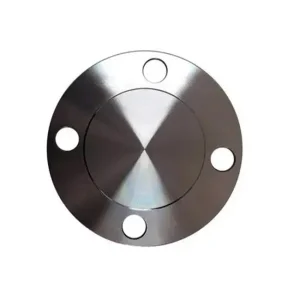
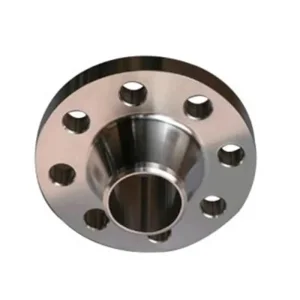
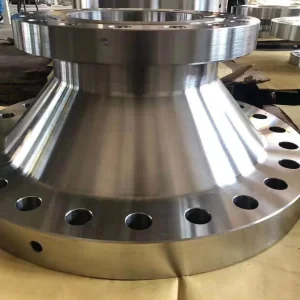
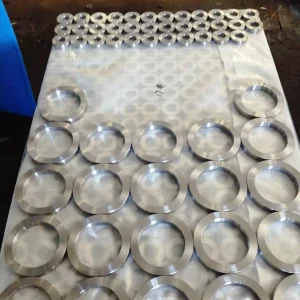
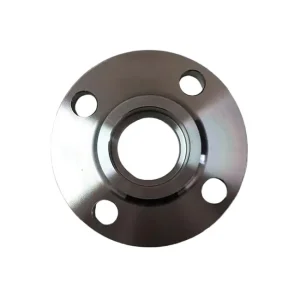
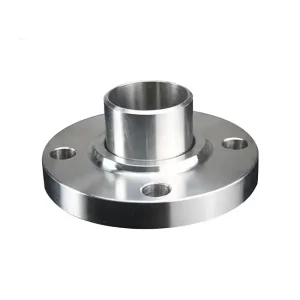
A comprehensive breakdown of mechanics, metallurgical optimization, and total cost of ownership (TCO) advantages of Lap Joint Flanges paired with Stub Ends.
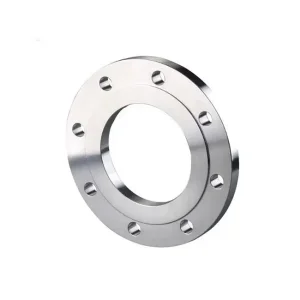
In modern industrial piping engineering, the selection of flange components impacts both long-term operational integrity and capital expenditure (CAPEX). A Lap Joint Flange (also referred to as a Loose Flange or Hubbed Lap Flange under ASME B16.5 / EN 1092-1 Type 02) features a dual-component architecture consisting of a loose backing flange and a matching stub end (lap end fitting). Unlike integral Weld Neck or Slip-On flanges that are directly welded to the pipe wall, a lap joint flange slides freely over the pipe exterior before being backed against the shoulder of a stub end butt-welded to the line.
The core mechanical advantage of this two-piece assembly lies in its operational decoupling: the stub end provides the fluid-wetted sealing surface and internal pressure retention, while the loose backing flange carries the bolting load and mechanical clamping force. This structural separation unlocks significant engineering and financial benefits, particularly when working with corrosive media, high-grade alloy piping systems, or lines requiring frequent operational disassembly.
When torque is applied to the flange bolts, axial tension is transmitted through the loose flange hub onto the curved back fillet of the stub end lap. ASME B16.5 standards strictly specify the matching radius between the flange bore fillet and the stub end shoulder to prevent localized stress risers under thermal expansion or cyclic loading. Because the backing flange is not wetted by the line fluid, engineers can utilize economic carbon steel (e.g., ASTM A105) for the heavy bolting ring, while specifying corrosion-resistant alloys such as ASTM A182 F316L, Duplex UNS S31803, or Hastelloy C276 strictly for the stub end.
| Flange Type | ASME / EN Standard | Fluid Contact | Alignment Flexibility | Relative CAPEX (Alloy Lines) | Maintenance Labor |
|---|---|---|---|---|---|
| Lap Joint (Loose Hub) | ASME B16.5 / EN 1092-1 Type 02 | Stub End Only | 360° Free Rotation | Lowest (-45% Alloy Saving) | Fastest Fit-up |
| Weld Neck (WN) | ASME B16.5 / EN 1092-1 Type 11 | Integral Flange Body | Fixed (Zero Rotation) | High (Full Alloy Body) | Requires Line Cutting |
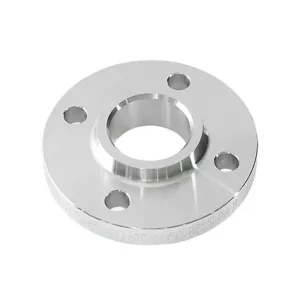
| Slip-On (SO) | ASME B16.5 / EN 1092-1 Type 12 | Integral Flange Body | Fixed (Zero Rotation) | Moderate | Double Fillet Weld |
| Socket Weld (SW) | ASME B16.5 Class 150-1500 | Integral Flange Body | Fixed (Zero Rotation) | Moderate | Crevice Corrosion Risk |
How global piping designers and EPC contractors leverage Lap Joint Flange assemblies to solve complex site challenges.
In seawater reverse osmosis (SWRO) facilities and chemical plants handling concentrated mineral acids, piping systems require Super Duplex (UNS S32750) or Titanium stub ends. Using carbon steel ASTM A105 loose backing flanges coated with epoxy or hot-dip galvanizing drastically reduces procurement costs while maintaining total immunity to internal pitting corrosion.
Petrochemical coking units and mineral slurry lines suffer heavy internal abrasion, requiring routine pipe segment rotation or replacement. Lap joint flanges allow maintenance technicians to quickly unbolt, rotate the pipe body 90 degrees to distribute wear evenly, and re-bolt without breaking welded connections, cutting turnaround downtime by up to 60%.
During modular pipe skid assembly in tight spaces, aligning bolt holes across multiple pre-welded spool pieces is a major field challenge. Lap joint flanges allow technicians to freely spin the backing ring to match mating bolt patterns perfectly, completely eliminating field re-welding caused by angular misalignment.
Inside Shanxi Yuxin Casting & Forging Co., Ltd.: Leveraging 33+ years of metallurgical heritage in China's premier forging capital.
When procuring bulk pipeline components, global buyers must balance competitive pricing with stringent quality control and supply stability. Located in the Zhuangli Industrial Zone of Dingxiang County, Shanxi Province—officially recognized as the “Hometown of Forging in China”—Shanxi Yuxin Casting & Forging Co., Ltd. (Est. 1992) operates an integrated manufacturing ecosystem capable of producing over 10,000 tons of forged flanges annually.
Unlike trading houses or localized machine shops, Shanxi Yuxin maintains end-to-end control over every step of the forging lifecycle:
The concentration of raw material suppliers, specialized toolmakers, and skilled metallurgical labor in Shanxi allows Shanxi Yuxin to achieve unmatched operational efficiency. These structural cost advantages translate directly into "discount" wholesale pricing for global distributors, EPC contractors, and end-users, backed by EN 10204 3.1 and PED 2014/68/EU certification.
Pioneering Next-Generation Manufacturing Technologies for Extreme-Service Pipeline Flanges (2025–2030).
Integration of infrared optical pyrometers and automated robotic manipulators ensures precise forging temperature windows (1150°C–850°C), eliminating thermal stress voids and ensuring consistent yield strength across heavy-wall flange batches.
To further reduce alloy consumption, advanced laser cladding techniques deposit thin layers of Inconel 625 or Stellite directly onto carbon steel stub end sealing faces, delivering super-alloy performance at a fraction of solid-alloy costs.
Implementing digital QR-code tagging directly onto flange rims allows field engineers to instantaneously scan and retrieve EN 10204 3.1 Mill Test Certificates, NDT inspection logs, and heat number history on site.
Adhering strictly to international pressure vessel directives and standard engineering codes.
Critical fluid containment demands total regulatory compliance. Shanxi Yuxin operates under an audited ISO 9001:2015 Quality Management System and holds international product certifications required by European, American, and Middle Eastern inspection authorities:
Technical solutions and commercial answers curated by senior export engineers.
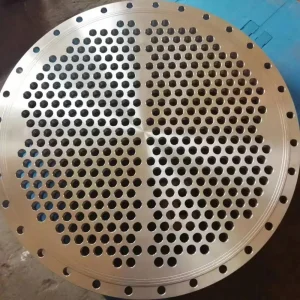
Browse our expanded catalog of specialized pipe flanges, tube sheets, and non-standard forged components.