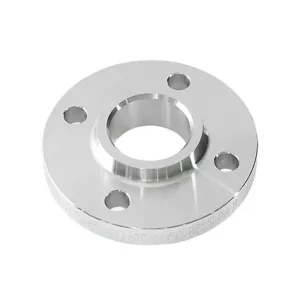
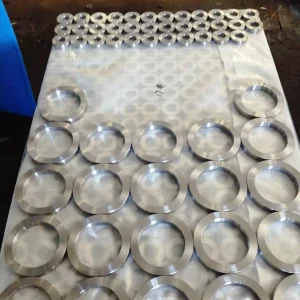
Explore our primary manufacturing lineup of heavy-duty industrial pipe flanges, forged with rigorous material traceability and precision dimensional control.
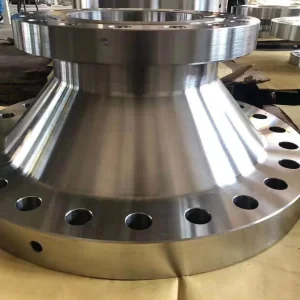
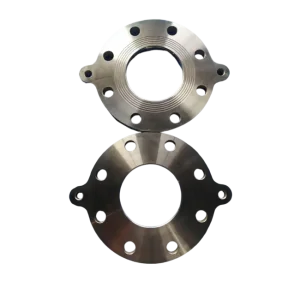
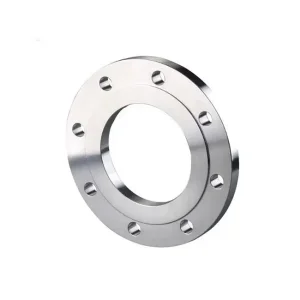
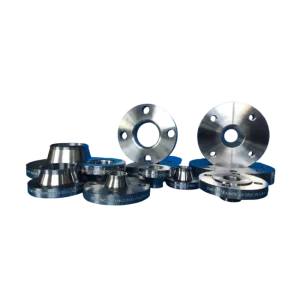
Understanding stress dissipation, hub neck geometry, and mechanical integrity in critical high-pressure piping networks.
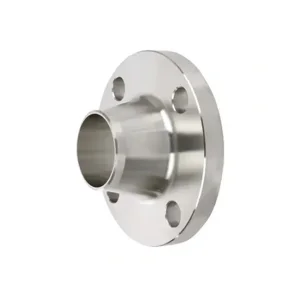
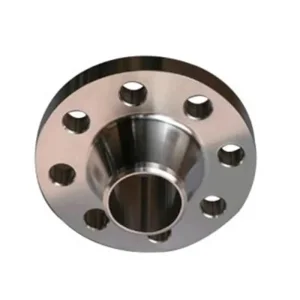
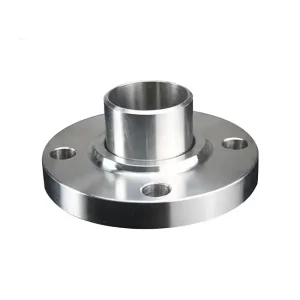
A Welding Neck Flange (also referred to as a tapered hub flange or high-hub flange) is designed to transfer stresses to the pipe, thereby reducing high stress concentrations at the base of the flange. The characteristic long tapered hub provides an indispensable mechanical reinforcement that smoothly transitions structural load into the pipe wall under dynamic loading environments.
The 1:3 ratio taper transition engineered into ANSI/ASME B16.5 and EN 1092-1 Type 11 designs ensures that hoop stress generated by internal fluid pressure and axial stress from line bending or thermal expansion are distributed homogeneously, preventing localized fatigue failures in high-vibration applications.
Unlike slip-on or socket weld flanges, a weld neck flange is bored to match the exact inside diameter (ID) of the mating pipe. This matching internal dimension prevents turbulence and erosion at the joint interface while allowing smooth fluid flow.
Our precise CNC machining aligns perfectly with all standard ASME wall thickness schedules—including Schedule 10, Schedule 40, Schedule 80, Schedule 160, Standard (STD), Extra Strong (XS), and Double Extra Strong (XXS). Matching bores eliminate restriction points, guaranteeing optimal thermal hydraulics across high-velocity transport media.
Dimensional integrity guarantees precise field alignment, flange facing seal integrity, and full interchangeability across global EPC projects.
When specifying Weld Neck Flanges for international procurement, engineering teams reference standard dimensional charts defined by ASME B16.5 (for sizes 1/2" to 24"), ASME B16.47 Series A & B (for large diameter flanges 26" to 60"), and EN 1092-1 Type 11 (European metric standards). The key critical dimensions required for pipe layout modeling and procurement include:
Defines the outer perimeter clearance and precise bolt hole center distance required for flange alignment and torque calculations.
The tapered profile dimensions that ensure smooth stress transfer from the thick flange ring to the bevel profile of the pipe.
Total height of the flange component and the internal bore diameter tailored to match exact wall schedules (Sch 40, 80, XS, XXS).
| NPS (Inches) | Nominal Size (DN) | Outside Diameter O (mm) | Thickness C (mm) | Hub Base X (mm) | Hub Top AH (mm) | Length Y (Class 150) | Length Y (Class 300) | Bore B (STD Wall) |
|---|---|---|---|---|---|---|---|---|
| 1/2" | DN15 | 88.9 | 11.2 | 30.2 | 21.3 | 47.6 mm | 52.3 mm | 15.7 mm |
| 1" | DN25 | 108.0 | 14.3 | 49.3 | 33.4 | 55.6 mm | 61.9 mm | 26.7 mm |
| 2" | DN50 | 152.4 | 19.1 | 77.7 | 60.3 | 63.5 mm | 69.8 mm | 52.5 mm |
| 3" | DN80 | 190.5 | 23.9 | 108.0 | 88.9 | 69.8 mm | 79.4 mm | 77.9 mm |
| 4" | DN100 | 228.6 | 23.9 | 134.9 | 114.3 | 76.2 mm | 85.7 mm | 102.4 mm |
| 6" | DN150 | 279.4 | 25.4 | 187.5 | 168.3 | 88.9 mm | 98.4 mm | 154.1 mm |
| 8" | DN200 | 342.9 | 28.6 | 239.8 | 219.1 | 101.6 mm | 111.1 mm | 202.7 mm |
| 10" | DN250 | 406.4 | 30.2 | 295.1 | 273.0 | 101.6 mm | 117.5 mm | 254.5 mm |
| 12" | DN300 | 482.6 | 31.8 | 355.6 | 323.8 | 114.3 mm | 130.2 mm | 304.8 mm |
Welding Neck Flanges are available in multiple facing configurations depending on pressure rating and joint sealing requirements: Raised Face (RF) with smooth or stock serrated finish (125-250 µin AARH), Ring Type Joint (RTJ) with octagonal or oval groove geometry for ultra-high pressure oilfield service (Class 900 to 2500), and Flat Face (FF) for mating with cast iron or fragile equipment flanges. Proper gasket interaction is vital to prevent fugitive emissions.
Combining world-class forging infrastructure in Shanxi with rigorous international certification, Chinese suppliers deliver uncompromised quality at scale.
Located in Shanxi Province, Dingxiang County is globally recognized as the "Hometown of Forging." The region boasts an unparalleled integrated industrial cluster housing steel billet production, ring-rolling mills, heat-treatment facilities, and high-precision CNC machining centers within a single geographic radius.
This density of specialized sub-tier suppliers yields massive economies of scale, shortening raw material lead times and providing immediate access to forged carbon steel (ASTM A105, Q235B), low-temperature steel (ASTM A350 LF2), and alloy/stainless grades (A182 F304/316L, F51 Duplex).
Modern Chinese flange factories have transitioned from traditional manual lathes to fully automated multi-axis CNC machining centers and robotic ring-rolling presses. This technological upgrade guarantees sub-millimeter tolerances on flange thickness, hub taper angles, bolt hole pitch circles, and gasket surface serrations.
Automated machining eliminates human error, ensuring 100% compliance with ASME B16.5 and EN 1092-1 dimensional specifications across high-volume OEM orders.
Leading China manufacturers operate audited quality management systems compliant with ISO 9001:2015, European Pressure Equipment Directive (PED 2014/68/EU), and AD 2000-Merkblatt W0. Every production batch is backed by EN 10204 3.1 Material Test Certificates (MTC).
Comprehensive non-destructive testing (NDT)—including Ultrasonic Testing (UT), Magnetic Particle Inspection (MT), and Positive Material Identification (PMI)—ensures zero internal voids or material grade mix-ups.
Where high temperatures, cryogenic fluids, and corrosive media demand high-integrity forged piping connections.
In oil refineries, fluid streams carry volatile hydrocarbons under high pressure and temperature conditions. Weld neck flanges forged from ASTM A105 carbon steel or A182 F11/F22 chrome-moly steel are specified for catalytic cracking units, hydrotreaters, and flare lines. The smooth hub transition minimizes turbulent stress corrosion cracking (SCC) caused by hydrogen embrittlement or sour gas (H2S) exposure in compliance with NACE MR0175/ISO 15156.
Liquefied Natural Gas (LNG) transport requires piping components capable of maintaining high impact toughness at cryogenic temperatures down to -196°C (-320°F). Our specialized ASTM A350 LF2 Class 1/2 and A182 F316L stainless steel weld neck flanges undergo Charpy V-notch impact testing to ensure flawless ductility, preventing brittle fractures in LNG regasification plants and cryogenic storage tanks.
Subsea oil extraction exposes piping hardware to immense external hydrostatic pressures, severe wave fatigue, and corrosive saltwater environments. High-yield duplex and super duplex stainless steel flanges (UNS S31803 / S32750 / F51 / F53) equipped with Ring Type Joint (RTJ) metal gaskets deliver leak-proof integrity up to Class 2500 rating, protecting offshore FPSO vessels and deepwater wellheads.
Supercritical steam piping in power plants operates under constant thermal cycling and high pressure. Weld neck flanges provide superior creep rupture strength compared to slip-on connections. Forged from high-temperature alloy steels, these flanges withstand intense thermal shock in boiler feedwater systems, main steam headers, and steam turbine inlet valves.
How international EPC contractors and piping distributors evaluate, qualify, and inspect China flange manufacturers.
Global buyers must verify that every flange is stamped with a unique heat number that links directly to its Mill Test Certificate. A compliant 3.1 certificate outlines heat chemistry (C, Mn, Si, P, S, Cr, Ni, Mo content), mechanical strength (tensile, yield, elongation), heat treatment lot (normalizing, solution annealing), and non-destructive examination (NDE) verification. Third-party inspection (TPI) by SGS, TÜV, or Bureau Veritas (EN 10204 3.2) can be arranged prior to export shipment.
Procurement engineers must audit critical tolerances per ANSI B16.5 Table 9: Outside Diameter (±2.0 mm for NPS ≤ 24"), Bore Diameter (±0.8 mm for 1/2" to 10", ±1.6 mm for 12" to 18"), Thickness (C) (+3.0 mm / -0 mm), and Bolt Hole Pitch Circle (±0.8 mm). Adherence to these strict limits ensures trouble-free field alignment and fit-up welding on automated pipeline construction rigs.
Ocean logistics subject carbon steel components to high humidity and salt vapor. Premium China suppliers apply rust-inhibiting black paint, yellow varnish, or transparent anti-rust oil to flange surfaces. Machined gasket faces are protected with plastic end-caps or wooden covers, and bulk orders are packed in ISPM-15 compliant fumigation-free plywood crates or steel-strapped pallets for safe containerized transport.
Smart manufacturing, green metallurgy, and digital quality control are revolutionizing flange production standards.
To meet global carbon-neutral mandates (ESG targets), leading Chinese flange manufacturers are transitioning from traditional coal gas heating furnaces to high-efficiency electric induction heating systems. Electric induction heating dramatically reduces carbon dioxide emissions per ton of forged steel while delivering precise temperature control, reducing surface scaling, and improving grain structure uniformity during hot die forging.
Advanced procurement systems now demand real-time digital traceability. By scanning QR codes laser-etched onto the flange rim, site engineers can instantly access a digital twin cloud database containing raw billet certificates, heat-treatment temperature logs, 3D laser scan inspection reports, and shipping manifests. This technology minimizes fraud and ensures authentic material deployment in nuclear and aerospace installations.
Detailed answers to essential questions asked by piping engineers, quality auditors, and procurement managers.
A Welding Neck Flange features a long tapered hub that is butt-welded to the matching pipe end, providing high structural strength and stress distribution suitable for high-pressure, extreme temperature, and cyclic loading applications. In contrast, a Slip-On Flange slides over the pipe end and is secured via two fillet welds (inside and outside). While slip-on flanges are easier to align and less expensive initially, their pressure-containing capacity under fatigue is approximately one-third that of a weld neck flange.
The bore of a Weld Neck Flange must be specified to match the exact inside diameter (ID) of the connecting pipe wall schedule (e.g., STD, XS, XXS, Sch 40, Sch 80, Sch 160). Matching the bores prevents step transitions at the welded joint, thereby eliminating flow turbulence, erosion, and localized pressure drops inside the piping system.
ASME B16.5 standards cover pressure-temperature ratings divided into seven pressure classes: Class 150, Class 300, Class 400, Class 600, Class 900, Class 1500, and Class 2500. The allowable working pressure depends on both the pressure class and the operating temperature of the fluid medium as specified in ASME B16.5 rating tables.
ASTM A105 carbon steel forgings feature maximum limits of 0.35% Carbon, 0.60–1.05% Manganese, 0.035% Phosphorus, 0.040% Sulfur, and 0.10–0.35% Silicon. For flanges rated above Class 300 or operating at design pressures/temperatures requiring enhanced toughness, ASTM A105 forgings undergo heat treatment consisting of normalizing, annealing, or quenching and tempering to refine the grain structure.
ASME B16.47 covers large diameter carbon steel flanges from NPS 26 through NPS 60. Series A (originally MSS SP-44) flanges are thicker, heavier, and feature larger bolt circles, making them ideal for heavy-duty industrial pipelines and valve connections. Series B (originally API 605) flanges feature smaller bolt holes and a compact design, offering cost and weight savings for compact process piping networks. Series A and Series B flanges are not dimensionally interchangeable.
Standard export documentation includes an EN 10204 3.1 Material Test Certificate (MTC) detailing heat chemistry, mechanical properties, NDT test results, and heat treatment batch details. Additional export documentation includes Commercial Invoice, Packing List, Certificate of Origin (Form E, Form F, or CO), Bill of Lading, and ISPM-15 Wood Packaging Fumigation Certificate.
Browse our complementary catalog of slip-on, expansion joint, ring, and custom drawing-based flange products.