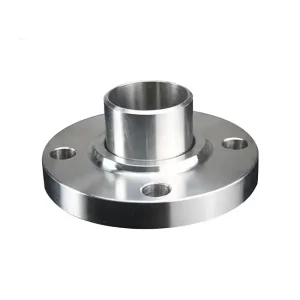
Explore certified OEM/ODM flange solutions manufactured under strict ASME B16.5, EN 1092-1, and DIN parameters for global export.
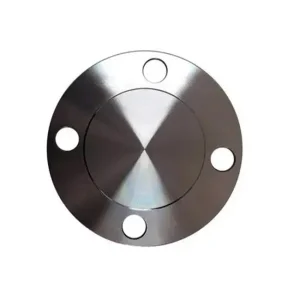
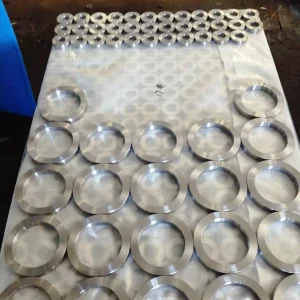
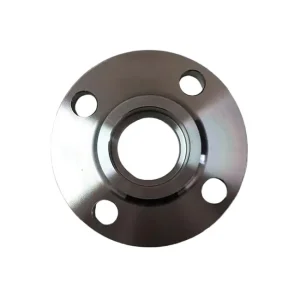
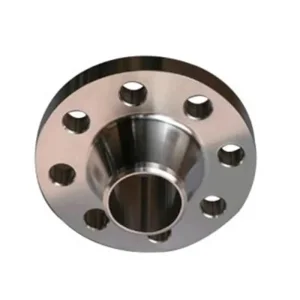
Global energy transmission networks, petrochemical refining plants, and municipal fluid management systems are undergoing a systemic transition toward higher operational pressures, extreme temperature resilience, and zero-emission environmental compliance. Pipeline flanges—the foundational mechanical joints connecting pipes, valves, pumps, and pressure vessels—represent the critical link in system integrity. A single joint failure can induce catastrophic environmental contamination, costly unplanned downtime, and severe safety hazards.
Within this rigorous engineering landscape, modern China pipeline flanges manufacturers have evolved from high-volume standardized suppliers into sophisticated engineering hubs capable of delivering bespoke metallurgical solutions. Utilizing advanced closed-die forging, high-precision CNC machining, and automated non-destructive testing (NDT), Chinese manufacturing enterprises now anchor global supply chains for major Engineering, Procurement, and Construction (EPC) conglomerates across the Americas, Europe, the Middle East, and Asia-Pacific.
The strategic concentration of raw material synthesis (such as low-alloy, carbon, and stainless steel billets from top-tier mills like TISCO and Baosteel), combined with integrated forging clusters in Shanxi (Dingxiang hub) and Jiangsu, gives Chinese suppliers an unparalleled structural advantage in delivery timelines, economies of scale, and custom alloy engineering.
A deep breakdown of technological capabilities, grain boundary refinement, and manufacturing automation driving superior component reliability.
Leading Chinese facilities control the entire production chain: from raw billet spectral chemistry verification, hydraulic press ring-rolling, computerized heat treatment (Normalizing, Quenching, Tempering), to fine lathe turning and drill press operations. This eliminates third-party outsourcing delays and guarantees uniform heat-lot consistency.
By employing high-tonnage hydraulic forging presses (up to 8,000 tons) and precision ring-rolling mills, Chinese manufacturers eliminate internal voids, porosity, and micro-segregation. Continuous plastic deformation refines the steel's internal grain flow, significantly enhancing tensile strength, yield stress, and Charpy V-notch impact toughness under cryogenic conditions.
China's comprehensive industrial supply chains lower production overhead without compromising quality. Proximity to major ports (Tianjin, Qingdao, Shanghai) and raw steel production bases translates into reduced logistical frictions, giving global buyers up to 25–35% total cost of ownership (TCO) savings compared to Western counterparts.
| Standard / Norm | Flange Types Available | Pressure Ratings | Material Specifications |
|---|---|---|---|
| ASME B16.5 / B16.47 (Series A & B) | Weld Neck (WN), Slip-On (SO), Blind (BL), Socket Weld (SW), Threaded (TH), Lap Joint (LJ) | Class 150, 300, 400, 600, 900, 1500, 2500 | ASTM A105, A350 LF2/LF3, A182 F304/304L, F316/316L, F11, F22, F51 (UNS S31803), F53 |
| EN 1092-1 (European Standard) | Type 01 (Plate), Type 02 (Loose), Type 11 (Weld Neck), Type 12 (Hubbed Slip-on), Type 05 (Blind) | PN 6, PN 10, PN 16, PN 25, PN 40, PN 63, PN 100, PN 160, PN 320, PN 400 | P245GH, P280GH, P250GH, S235JR, 1.4301, 1.4404, 1.4462 (Duplex 2205) |
| DIN / JIS / GOST | Standard Hubbed, Flat Ring Flanges, Smooth & Serrated Facing Types | 10K, 16K, 20K, 30K / GOST 12820-80 (1.6 to 2.5 MPa) | C22.8, St37.2, SUS304, SUS316, 20#, 09G2S Carbon & Alloy Steels |
| API 6A / API 17D (Wellhead & Subsea) | Type 6B, 6BX Flanges, Swivel Ring Flanges, Target Flanges | 2,000 PSI to 20,000 PSI | AISI 4130, 4140, Inconel 625 Clad, Incoloy 825, Super Duplex F55 |
The global fluid transmission sector is rapidly evolving. Progressive pipeline flange manufacturers in China are actively investing in R&D to meet the upcoming challenges of energy transition and extreme environment operations.
Hydrogen molecules cause micro-cracking and hydrogen embrittlement in standard carbon steels. Chinese manufacturers are pioneering ultra-clean, low-sulfur steel formulations with tight control over carbon equivalent (CEq) values and micro-alloying elements (Vanadium, Niobium) to ensure zero permeability for pure H2 and hydrogen-natural gas blends.
Offshore exploration is pushing into deeper waters exceeding 2,000 meters. Chinese specialized mills produce forged Swivel Ring Flanges and Compact Flanges (per ISO 27509) using Nickel-alloy weld overlays (Inconel 625 cladding via automated hot-wire TIG welding) to combat aggressive marine corrosion and sour gas (H2S + CO2) environments.
Industry 4.0 integration has transformed quality verification. Laser-etched QR codes and RFID tags are directly applied to flange rims during machining. Scanning provides instant digital access to the mill test certificate (MTC EN 10204 3.1/3.2), 3D coordinate measurement data, ultrasonic test heat maps, and carbon footprint metrics.
Tailored mechanical joining solutions engineered to meet the operational stresses of diverse industrial landscapes.
Challenge: High cyclic thermal expansion, aggressive hydrocarbon media, fugitive emission risks.
Solution: ASME B16.5 High-Hub Weld Neck Flanges forged in ASTM A182 F316L/F11 with Spiral Wound Gasket faces (AARH 125-250 serrated finish) guaranteeing leakage rates below 10-5 mbar·l/s under TA-Luft / ISO 15848-1 standards.
Challenge: Temperatures dropping to -196°C, requiring material resistance against brittle fracture.
Solution: Charpy V-Notch impact-tested ASTM A350 LF2 / Stainless F304L flanges subjected to liquid nitrogen cryogenic testing, delivering high Charpy energy absorption (>40J at -196°C).
Challenge: Field bending forces, soil movement, rapid field welding requirements.
Solution: MSS SP-44 / API 5L High-Yield Weld Neck Flanges (Grades F42 to F70) featuring custom matched pipe bores for seamless manual and automated field butt-welding.
Challenge: Extreme atmospheric salinity, splash-zone pitting, high mechanical fatigue.
Solution: Super Duplex 2507 (UNS S32750) and 254SMO custom ring flanges with PREN (Pitting Resistance Equivalent Number) >42, protected by three-layer epoxy coating systems.
Sourcing pipeline components globally demands rigorous quality verification to mitigate engineering risk. Leading Chinese flange factories adhere strictly to international auditing protocols and provide comprehensive documentation packages accepted by major global operators (e.g., Aramco, ADNOC, Shell, Chevron, BP).
Every shipment is backed by a full Mill Test Certificate (MTC) detailing complete ladle melt chemistry, heat treatment curves (temperature, soak time, cooling medium), microstructural grain size analysis, tensile/yield data, and hardness profile (HBW/HRC).
Standard quality protocols include Ultrasonic Testing (UT per ASTM A388) for detecting internal forging laminations, Magnetic Particle Testing (MT) or Liquid Penetrant Inspection (PT) for surface defects, and Positive Material Identification (PMI) XRF handheld analyzer checks prior to packing.
Chinese production lines seamlessly accommodate third-party inspection agencies including SGS, TÜV Rheinland, Bureau Veritas (BV), Lloyd's Register (LR), and DNV. TPI inspectors conduct witness points for final dimensional checks, hydrostatic shell testing, and container loading supervision.
Expert insights addressing real-world queries from piping engineers, buyers, and EPC procurement leads.
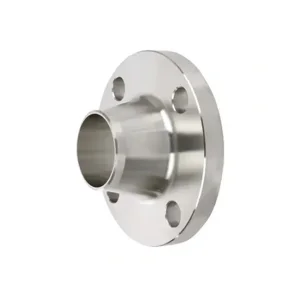
Weld Neck flanges feature a long, tapered hub that provides gradual stress distribution into the attached pipe, making them ideal for high-pressure, high-temperature, or cyclic loading applications (Class 300 to 2500). Slip-On flanges slip over the pipe and are secured by two fillet welds (inside and outside). SO flanges are easier to align in low-pressure, low-rigidity environments (Class 150 to 300) and carry a lower initial purchase cost.
For sour environments containing hydrogen sulfide (H2S), Chinese mills utilize vacuum-degassed steel with restricted chemical limits (Sulfur < 0.005%, Phosphorus < 0.010%). Post-forging heat treatment (Normalizing + Tempering or Solution Annealing) guarantees hardness levels remain strictly below 22 HRC (237 HBW). HIC (Hydrogen-Induced Cracking) and SSCC (Sulfide Stress Corrosion Cracking) laboratory testing are performed per NACE TM0177 / TM0284.
Per ASME B16.5, raised face (RF) flanges are supplied with a serrated concentric or spiral (phonographic) finish ranging from 125 to 250 micro-inches (3.2 to 6.3 micrometers) AARH/Ra to ensure proper gasket seating and mechanical bite. Flat Face (FF) and Ring Type Joint (RTJ) grooves are machined to smooth finishes (Ra < 1.6 μm for RTJ grooves to ensure metal-to-metal seal integrity).
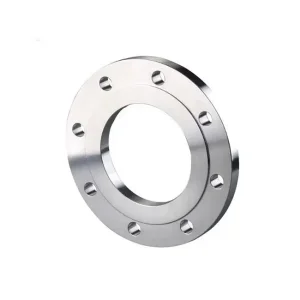
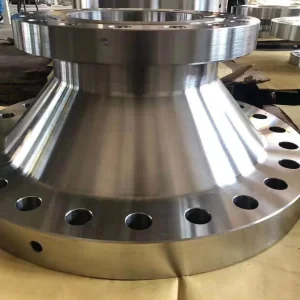
Yes. Beyond standard ASME, EN, DIN, and JIS norms, Chinese factories specialize in custom forging based on CAD/DWG drawings. This includes non-standard bolt hole circles, heavy-wall hubs, custom tube sheets for heat exchangers, large-diameter rolled rings up to 3,000mm outer diameter, and special reducer flanges. In-house die creation allows fast prototyping and short lead times.
Finished flanges undergo surface passivation or anti-rust treatment, such as black rust-preventive paint, yellow varnish, transparent oil coating, or hot-dip galvanizing. Machined flange faces are fitted with plastic bevel caps or wooden cover plates to prevent mechanical impact damage. Products are then wrapped in moisture-proof plastic film, desiccant packs are inserted, and items are secured in ISPM-15 compliant fumigation-free plywood crates.
For standard carbon steel flanges (e.g., A105 Weld Neck Class 150/300), standard forging blanks are kept in stock, allowing machining and export within 7 to 15 days. For custom alloy forgings, high-pressure forged rings, or large-lot EPC project schedules, typical manufacturing cycles range from 20 to 35 days. Low MOQs are accommodated for initial sample validations or stock replenishment orders.
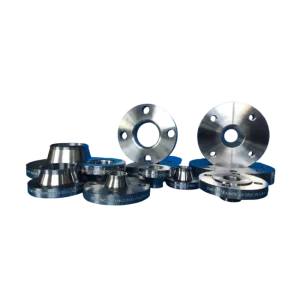
Discover additional factory-direct forged flange variants, custom stub ends, plain flanges, and weld necks engineered for long-term piping durability.