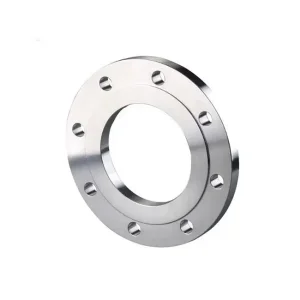
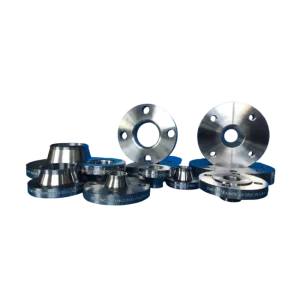
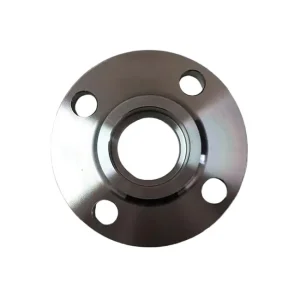
Explore our top-tier export-ready forged flanges engineered for high-pressure industrial applications, petro-chemical pipelines, and precision flow measurement.
Orifice flanges serve a highly critical, specialised role in fluid transportation infrastructure: enabling non-intrusive, continuous, and high-precision flow rate metering via differential pressure measurement across processing pipelines.
Unlike standard pipe flanges governed strictly by ASME B16.5 or EN 1092-1—which primarily function as removable structural joints—an Orifice Flange Assembly manufactured under ASME B16.36 incorporates specialized structural features. These include integrated radial differential pressure tapping holes (taps), jack screw mechanisms for gasket separation, and calibrated internal bores matched to specific orifice plates. By utilizing Bernoulli’s principle, the restriction created by an orifice plate clamped between a pair of orifice flanges creates a measurable pressure drop proportional to the fluid flow rate.
While standard ASME B16.5 flanges are optimized for structural integrity and leak-tight joint seal integrity, ASME B16.36 Orifice Flanges feature extended hub lengths, increased flange thickness, and machined 1/2" NPT or socket weld radial tap holes centered exactly 1 inch (25.4 mm) from the flange face. Shanxi Yuxin Casting & Forging Co., Ltd. integrates 5-axis CNC machining to guarantee concentricity and tolerance precision within ±0.12 mm, eliminating measurement distortion caused by turbulent flow micro-eddies.
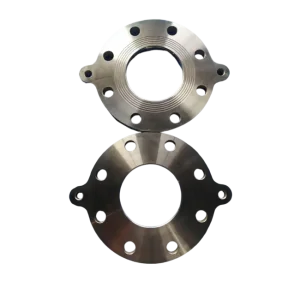
Equipped with dual differential pressure tappings (typically 1/2" NPT female threads or socket weld connections) machined directly into the flange body, eliminating the need for expensive orifice carriers.
Features dedicated jack screws threaded into the outer flange rim. This enables engineers to smoothly separate the flange faces during maintenance without damaging sensitive orifice plates or gaskets.
Custom-machined internal bores matching exact pipe schedules (Schedule 40, 80, 160, XXS) to prevent internal step discontinuities that disrupt laminar fluid boundary layers.
Choosing the ideal orifice flange configuration requires analyzing process pressure, operating temperature, fluid viscosity, and piping stress dynamics. Leading Chinese manufacturers produce three primary structural variants compliant with global standards.
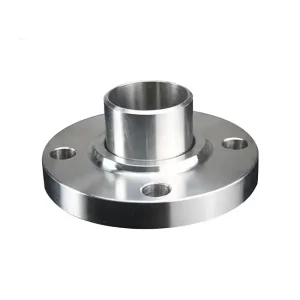
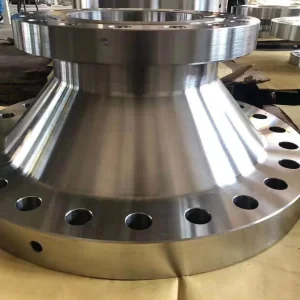
Industry Standard for High-Pressure & Critical Services: Designed with a long tapered neck welded directly to the pipe. This transfers structural stress from the flange body to the pipeline itself, minimizing stress concentrations at the joint base.
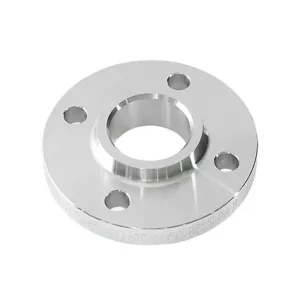
Economical Solution for Low-to-Medium Pressure: The pipe slips into the flange bore and is secured with two fillet welds (one internal, one external). Machining pressure taps directly into the slip-on hub requires enhanced flange wall thickness.
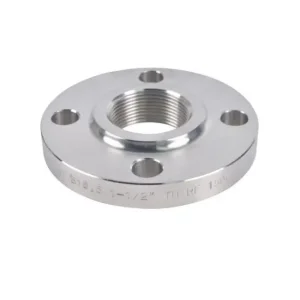
No-Weld Solution for Hazardous Environments: Internally threaded to accept male-threaded pipes. Commonly utilized where post-weld heat treatment (PWHT) is impossible or in explosive gas zones where open welding is prohibited.
| Flange Type | Pressure Class Range | Nominal Size Range | Primary Facing Types | Nondestructive Testing (NDT) | Typical Industrial Media |
|---|---|---|---|---|---|
| Weld Neck (WNOF) | Class 300 – 2500 | 1" to 24" (DN25 – DN600) | RF (125-250 AARH), RTJ (R, RX, BX) | 100% Radiographic / Ultrasonic | Crude Oil, High-Pressure Gas, Steam |
| Slip-On (SOOF) | Class 300 | 1" to 12" (DN25 – DN300) | Raised Face (RF) | Magnetic Particle / Liquid Penetrant | Cooling Water, Low-Pressure Hydrocarbons |
| Threaded (TOF) | Class 300 – 1500 | 1" to 8" (DN25 – DN200) | Raised Face (RF) | Visual / Hydrostatic Pressure Test | Instrument Air, Nitrogen, Utility Gases |
| Ring-Type Joint (RTJ) | Class 600 – 2500 | 2" to 24" (DN50 – DN600) | Octagonal / Oval Ring Groove | UT + Ultrasonic Flaw Detection | Sour Gas (H2S), High-Temp Refractory Fluid |
China’s industrial forging sector—centered in world-renowned clusters like Dingxiang County, Shanxi—delivers an unbeatable combination of metallurgical excellence, rapid prototyping, and end-to-end supply chain integration.
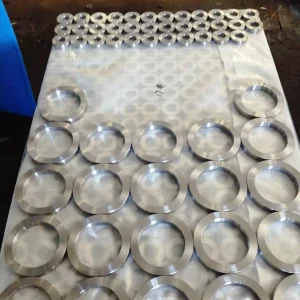
Leading manufacturers like Shanxi Yuxin Casting & Forging Co., Ltd. operate complete in-house production ecosystems: raw ingot heating, hydraulic die forging, closed-loop heat treatment (normalizing/tempering), precision CNC turning, dynamic tapping, and final NDT testing under one roof.
Chinese suppliers strictly enforce material traceability in accordance with EN 10204 3.1 / 3.2. Every batch of carbon steel (ASTM A105, A350 LF2), alloy steel (A182 F11/F22), or duplex stainless steel (F304/F316L, Duplex 2205) undergoes positive material identification (PMI) and grain refinement inspection.
By leveraging mature local raw material procurement and automated manufacturing hubs, Chinese factories offer high-precision ASME B16.36 Orifice Flanges at highly competitive price points, providing international procurement officers with significant TCO (Total Cost of Ownership) savings.
YUXIN Flange maintains rigorous international credentials, including ISO 9001:2015 Quality Management Systems, PED 2014/68/EU Pressure Equipment Directive certification, and AD 2000-Merkblatt W0 compliance assessed by TÜV CERT. Every export shipment is issued with comprehensive EN 10204 3.1 Mill Test Certificates detailing heat chemistry, mechanical yield/tensile strength, impact values down to -46°C, and hydrostatic pressure test logs.
Orifice flange assemblies are deployed across high-reliability energy networks, chemical processing facilities, and heavy industrial plants worldwide.
In fluid catalytic cracking (FCC) and ethylene distillation columns, maintaining stable flow balances is imperative. Heavy-duty Weld Neck Orifice Flanges manufactured from ASTM A182 F316L or Duplex 2205 prevent high-temperature hydrogen attack (HTHA) and deliver precise differential pressure feedback to SCADA control systems.
Custody transfer points demand ultra-precise flow metering to guarantee financial transaction accuracy between gas producers and distribution utilities. Machined RTJ orifice flanges (Class 900 to 2500) paired with micro-honed orifice plates meet ISO 5167 and AGA Report No. 3 metering criteria under high line pressures.
Superheated main steam lines operate under extreme thermal cyclic loads. Forged alloy steel (ASTM A182 F11/F22) orifice flanges with full radial tap inspection prevent creep deformation, ensuring reliable long-term boiler efficiency monitoring.
Compact lightweight flange designs manufactured from Super Duplex 2507 or Nickel Alloy C276 resist aggressive chloride pitting in offshore topside processing units. NACE MR0175/ISO 15156 sour service compliance prevents sulfide stress cracking (SSC).
The industrial valve and flange sector is shifting rapidly towards digital integration, material longevity enhancements, and decarbonization technologies.
Modern orifice flange assemblies are increasingly pre-fitted with wireless digital differential pressure transmitters and RTD temperature sensors directly at the tap ports, reducing field installation time and dynamic signal loss.
With the expansion of the green hydrogen economy and LNG transportation, orifice flanges must withstand ultra-low temperatures (-196°C) and hydrogen embrittlement. Advanced forging methods utilize ultra-low carbon micro-alloying and liquid nitrogen quench heat treatments.
Leading Chinese forging plants utilize 3D optical scanning and AI-assisted ultrasonic flaw detection to construct digital twins of every flange. This allows end-users to verify flange face flatness and tapping thread geometry prior to shipment.
To ensure project execution efficiency and eliminate site delays, global EPC contractors and procurement officers should utilize this structured checklist when specifying orifice flanges from Chinese suppliers:
Confirm exact standard reference (ASME B16.36, MSS SP-44, or EN 1092-1 Type 11), pressure rating (Class 300 to 2500), line size, and pipe schedule thickness.
Specify tapping configuration: standard dual 1/2" NPT female taps (spaced at 90° or 180°), socket weld taps, or corner taps for low-Reynolds-number viscous fluids.
Mandate positive material identification (PMI), 100% radiographic testing (RT) on weld necks, ultrasonic testing (UT) on heavy forgings, and hardness testing per NACE MR0175.
Require rust-preventive varnish/epoxy coatings, plastic end-cap bore protectors, soft gasket face covers, and seaworthy fumigation-free plywood crate packaging.
Direct technical insights from our senior metallurgical engineers addressing common questions raised by global pipeline designers and procurement managers.
Browse our expanded catalog of premium forged flanges, lap joints, slip-ons, and specialty connectors engineered for global infrastructure development.