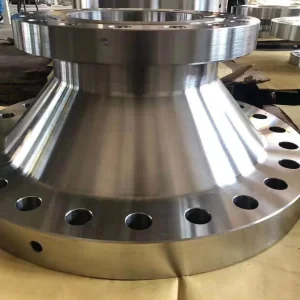
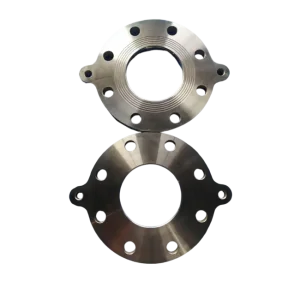
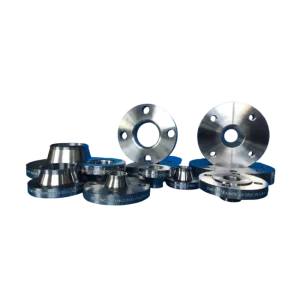
Browse our core manufacturing inventory engineered to ANSI/ASME B16.5, ASME B16.47, EN 1092-1, DIN, and JIS standard specifications.
An exhaustive analytical synthesis on metal procurement economics, supply chain resilience, and metallurgical standardization for high-integrity piping systems.
Modern energy and process engineering sectors require diversified, audit-proof supply networks. China's flange forging hubs—specifically centered around Shanxi's Dingxiang cluster—provide unmatched vertical integration from raw billet melting to high-precision CNC machining, insulating global EPC projects from severe supply shocks.
AISI (American Iron and Steel Institute) nomenclature defines strict chemical composition tolerances for carbon, alloy, and stainless steels. Leading Chinese suppliers adhere rigorously to AISI 304/304L, 316/316L, 321, and alloy grades like 4130, ensuring equivalent grain structures and corrosion resistance matching Western mill outputs.
The migration from conventional manual die forging to automated ring-rolling equipment and 5-axis CNC machining centers guarantees dimensional tolerances under ±0.1mm. High-speed optical scanning and automated ultrasonic testing (UT) eliminate internal voids before components reach export terminals.
Evaluating a Chinese AISI flange supplier requires looking beyond price per kilogram. Tier-1 manufacturers implement full closed-loop traceability: Electric Arc Furnace (EAF) steelmaking with Argon Oxygen Decarburization (AOD), controlled forging ratios (>3.5:1 for structural grain refinement), continuous solution annealing, and digital heat-number stamping verified via EN 10204 3.1 certification.
Comparative metallurgical matrix for specifying piping flanges across aggressive chemical, thermal, and mechanical loading environments.
| AISI Grade Designation | Equivalent ASTM / UNS | Nominal Chemical Composition | Tensile Strength (MPa) | Yield Strength (MPa) | Primary Industrial Application |
|---|---|---|---|---|---|
| AISI 304 / 304L | ASTM A182 F304/F304L (UNS S30403) | 18% Cr, 8% Ni, C ≤ 0.030% | ≥ 485 | ≥ 170 | General chemical handling, food processing, potable water networks. |
| AISI 316 / 316L | ASTM A182 F316/F316L (UNS S31603) | 16% Cr, 10% Ni, 2.0% Mo, C ≤ 0.030% | ≥ 485 | ≥ 170 | Marine piping, offshore platforms, chloride-rich process lines. |
| AISI 321 | ASTM A182 F321 (UNS S32100) | 17% Cr, 9% Ni, Ti ≥ 5x(C+N) | ≥ 515 | ≥ 205 | High-temperature exhaust manifolds, refinery crack unit headers. |
| AISI 4130 | ASTM A508 / UNS G41300 | 0.30% C, 1.0% Cr, 0.20% Mo | ≥ 655 | ≥ 517 | High-pressure oilfield choke & kill manifolds, subsea wellheads. |
| AISI 904L | ASTM A182 F904L (UNS N08904) | 20% Cr, 25% Ni, 4.5% Mo, 1.5% Cu | ≥ 490 | ≥ 220 | Sulfuric acid production, phosphoric acid plants, aggressive media. |
| Duplex 2205 | ASTM A182 F51 / UNS S31803 | 22% Cr, 5% Ni, 3% Mo, 0.17% N | ≥ 620 | ≥ 450 | Desalination plants, sour gas scrubbing, high-stress pipelines. |
Comprehensive mechanical breakdown of structural flange variants designed to withstand mechanical fatigue, thermal expansion, and bending moments.
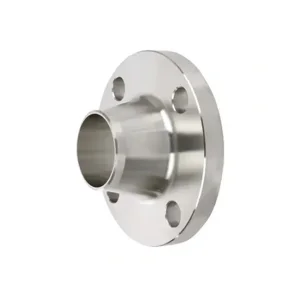
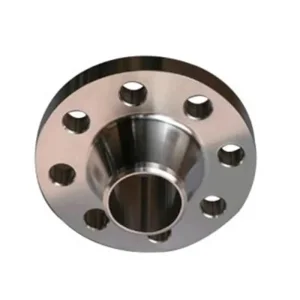
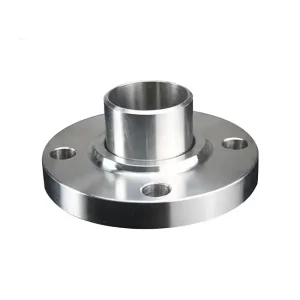
Designed with a long tapered hub that transitions stress smoothly into the pipe wall. Weld Neck flanges are the primary choice for high-pressure cyclic loading, sub-zero cryogenic duty, and elevated temperature services up to Class 2500 / PN400.
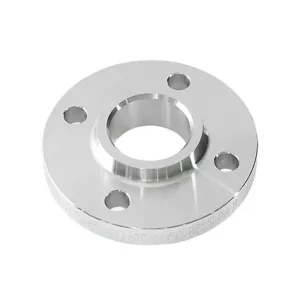
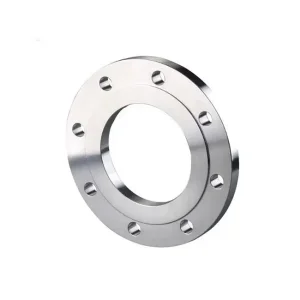
Slipped over the pipe end and welded on both internal and external sides. Highly economical and simple to align in low-pressure utility lines, water treatment, HVAC networks, and low-severity structural fabrications.
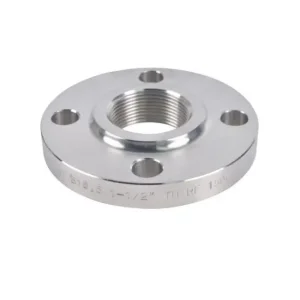
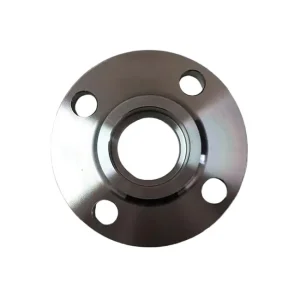
Socket Weld flanges incorporate a recessed counterbore for small-bore high-pressure piping (½" to 4"). Threaded (NPT/BSPT) variants enable rapid installation in hazardous environments where post-weld heat treatment (PWHT) or open flame permits are restricted.
Utilized in systems requiring frequent dismantling or alignment of bolt holes. The loose backing flange never comes into contact with the internal fluid, permitting carbon steel backing rings to pair with expensive stainless AISI 316L stub ends.
Solid forged discs used to seal off pipeline terminals or pressure vessel nozzles during maintenance. Engineered to handle maximum system hydrostatic test pressures, with optional drilled vent/drain ports upon customer request.
Custom-machined large-diameter forgings (up to Ø3,000mm) used in shell-and-tube heat exchangers, condensers, and flexible piping bellows, absorbing axial displacement and thermal expansion stress.
How Chinese AISI forged flanges are deployed in mission-critical operations worldwide under challenging environmental conditions.
Subsea production manifolds and Christmas trees operate under combination hazards: external hydrostatic pressure, internal sour gas (H₂S), and marine chloride corrosion. Chinese AISI 4130 and AISI 316L flanges destined for the North Sea and Gulf of Mexico undergo strict NACE MR0175/ISO 15156 testing, sulfide stress cracking (SSC) verification, and HIC evaluation to prevent sudden catastrophic brittle failure.
Liquefied Natural Gas (LNG) pipelines operate at cryogenic temperatures down to -196°C (-320°F). Low-carbon austenitic stainless steels (AISI 304L/316L) retain excellent face-centered cubic (FCC) crystal toughness at extreme low temperatures. Each batch undergoes Charpy V-Notch impact testing at full cryogenic limits, ensuring zero risk of brittle fracture transition.
Refinery fluid catalytic cracking (FCC) and ethylene furnace transfer lines demand materials capable of maintaining structural load capability without experiencing thermal creep deformation. AISI 321 and AISI 347 flanges, stabilized with titanium and niobium respectively, prevent intergranular chromium carbide precipitation during continuous operation between 427°C and 816°C.
Sanitary process lines require mirror-polished internal flange surfaces (Ra < 0.4 µm) to eliminate bacterial traps and prevent biofilm formation. Forged AISI 316L stainless steel flanges, combined with electropolishing treatments, deliver maximum resistance to aggressive Cleaning-in-Place (CIP) and Sterilization-in-Place (SIP) steam cycles.
Rigorous multi-stage quality verification protocols guaranteeing zero-defect export delivery.
Every forged flange undergoes Ultrasonic Testing (UT) to detect internal inclusions, cracks, or laminations. Flange sealing faces are subjected to Magnetic Particle Inspection (MPI) or Liquid Penetrant Inspection (LPI) to guarantee zero surface defects.
Full material test certificates (MTC) accompany every shipment, documenting chemical ladle analysis, mechanical tensile/impact strength, heat treatment temperature records, and Positive Material Identification (PMI) spectral verification.
To survive long-distance oceanic freight, flange faces receive rust-preventive oil or yellow varnish coatings. Sealing faces are protected with plastic caps, and items are packed in seaworthy, fumigation-free ISPM-15 compliant plywood cases.
Pioneering green metallurgy, AI-assisted quality control, and hybrid additive forging across China's manufacturing landscape.
The integration of Electric Arc Furnaces (EAF) powered by renewable solar and wind energy in Shanxi allows Chinese flange foundries to drastically reduce Scope 1 and Scope 2 carbon footprints, meeting EU Carbon Border Adjustment Mechanism (CBAM) compliance standards for European buyers.
Integrating computer-vision AI models directly into CNC machining centers enables real-time surface roughness analysis and flange facing serration verification (125-250 µin AARH finish), instantly discarding off-spec components before human inspection.
Combining heavy closed-die forging with Wire Arc Additive Manufacturing (WAAM) allows the creation of internal cooling channels and complex internal geometry in specialized AISI alloy flanges without sacrificing structural grain flow integrity.
Expert responses to critical procurement, metallurgical, and international standard queries.
AISI (American Iron and Steel Institute) designates the general chemical family and alloy grade (e.g., AISI 304, AISI 316L, AISI 4130). ASTM (American Society for Testing and Materials) defines the specific product form, heat treatment, testing requirements, and mechanical property standards for piping components. For example, a flange made from AISI 316L chemistry is manufactured and certified under the ASTM A182 Grade F316L standard for forged fittings and valves.
An EN 10204 3.1 Mill Test Certificate is validated by the manufacturer’s independent Quality Control department, confirming that the actual chemical analysis and mechanical testing of the supplied heat number match the standard. An EN 10204 3.2 Certificate requires an independent third-party inspection agency (such as TÜV, Lloyd’s Register, SGS, or Bureau Veritas) to witness the heat treatment, sample cutting, non-destructive testing, and hydro-testing before signing off on the release documentation.
ASME B16.5 mandates that Raised Face (RF) and Flat Face (FF) flanges used with standard spiral wound gaskets must feature a serrated concentric or spiral finish with a roughness of 125 to 250 microinches AARH (3.2 to 6.3 micrometers Ra). This serrated profile bites into the metallic gasket body, preventing lateral gasket blowouts under cyclic thermal and pressure loads.
During welding, standard stainless steel (AISI 304/316) is exposed to temperatures between 450°C and 850°C, causing carbon to bind with chromium to form chromium carbides along grain boundaries (sensitization). This depletes chromium near the grain boundaries, making the weld zone vulnerable to intergranular corrosion. "L" grades limit carbon to ≤ 0.030%, preventing carbide precipitation and eliminating the need for post-weld solution annealing.
Standard forged blanks held in stock can be machined, coated, and packaged within 10 to 15 days. Custom forged-to-order flanges requiring special alloy heat treatment or 3D measuring arm inspection take 25 to 35 days. For export shipping, flanges receive anti-rust oil coatings, protective plastic caps over bolt holes and faces, and are packed inside ISPM-15 compliant seaworthy plywood cases reinforced with outer steel strapping.
High-integrity reducers, expansion joints, stub ends, and specialized custom forgings.