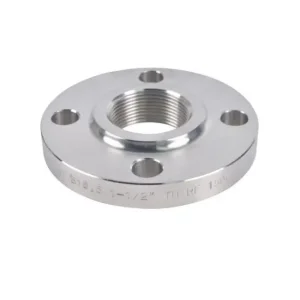
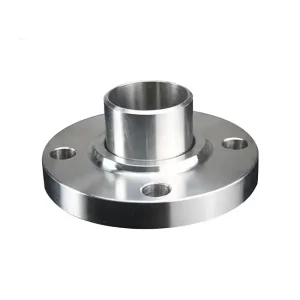
Explore our precision-machined forged flanges, tube sheets, and custom engineered piping components manufactured strictly to ASME, DIN, and EN specifications.
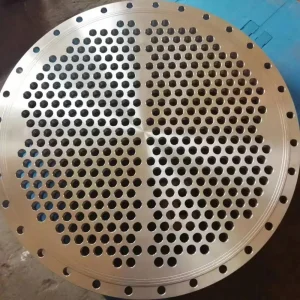
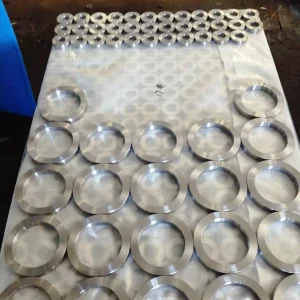
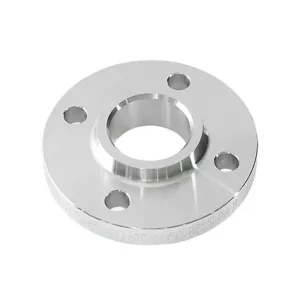
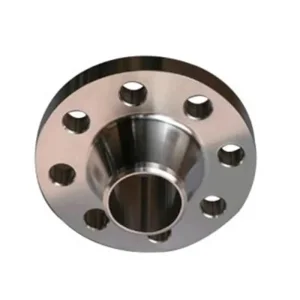
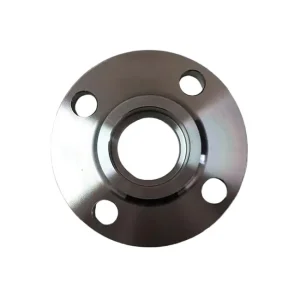
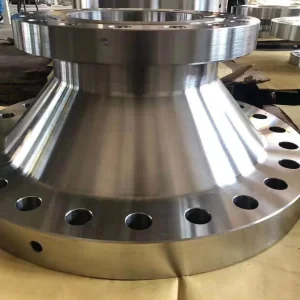
When specifying large-diameter steel flanges for high-pressure industrial pipelines, engineering procurement teams frequently evaluate ASME B16.47 Series B alongside Series A. Historically originating from the API 605 specification, Series B flanges are explicitly engineered for compact, weight-critical, and cost-optimized piping networks across sizes ranging from NPS 26 through NPS 60 (DN 650 to DN 1500).
The fundamental distinction between Series A (formerly MSS SP-44) and Series B lies in bolt circle geometry, flange thickness, and total weight. Series B flanges utilize smaller, more tightly spaced bolt holes. This design configuration requires smaller nominal bolt diameters compared to Series A for equivalent pressure ratings (Class 75, 150, 300, 400, 600, and 900). Consequently, Series B flanges offer a substantially reduced outer diameter and overall mass, resulting in lower raw material costs and lighter piping system deadweight—a vital factor in offshore oil platforms, FPSO vessel topsides, and modular chemical processing units.
| Design Parameter | ASME B16.47 Series B (API 605) | ASME B16.47 Series A (MSS SP-44) | Engineering Benefit of Series B |
|---|---|---|---|
| Bolt Circle Geometry | Smaller pitch circle with more numerous, smaller bolts | Larger pitch circle with fewer, larger diameter bolts | More uniform gasket load distribution & reduced torque wrench size requirements |
| Flange Weight & Profile | Compact profile; ~15% to 30% lighter overall mass | Heavy-duty profile; higher total mass and thickness | Substantial freight savings, lower material costs, easier structural handling |
| Valves & Piping Mating | Mates primarily with API 605 pipelines and compact valves | Standard mating for ASME B16.10 valves and equipment | Optimized for dedicated long-distance transmission line manifolds |
| Primary Application | Refinery piping, gas transport, FPSO, heat exchangers | Heavy municipal waterlines, severe subsea stress headers | Maximum cost efficiency in tight physical footprints |
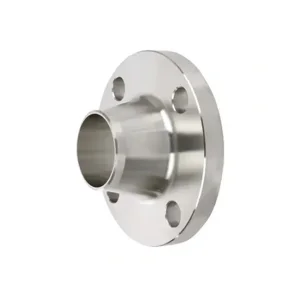
Designed with a long tapered hub that transfers stress smoothly into the pipe wall. Essential for cyclic loading, extreme temperatures, and 100% radiographed pressure joints.
Solid forged disks engineered to seal vessel nozzles and pipeline ends. Rigorously analyzed under finite element modeling (FEA) to resist high hydrostatic backpressure.
Preferred for low-pressure Class 75 and 150 utility lines. Offers easy alignment on site with double fillet welds inside and outside the flange hub.
The deployment of Series B large-diameter flanges spans across diverse geographical environments and aggressive industrial operating conditions. Selecting the ideal supplier demands deep alignment with localized environmental stressors, regulatory compliance frameworks, and project-specific mechanical loads.
High ambient temperatures exceeding 50°C combined with sour crude oil (H2S concentration) demand low-alloy carbon steels such as ASTM A350 LF2 and A182 F11/F22 with NACE MR0175/ISO 15156 compliance. Series B flanges are extensively deployed in cross-country oil manifolds across UAE, Saudi Arabia, and Qatar due to their compact footprint in skid-mounted units.
Offshore platforms in North-Western Europe and North America operate under extreme mechanical fatigue, wave action, and sub-zero temperatures (-40°C). Series B Weld Neck flanges forged from ASTM A182 F316L or Super Duplex UNS S32750 provide superior microstructural grain alignment, verified by Charpy V-Notch impact testing down to -46°C.
Liquefied Natural Gas (LNG) regasification terminals in Japan, South Korea, and China require forged flanges capable of maintaining gasket seat tightness at cryogenic temperatures (-196°C). High-alloy austenitic stainless steel Series B blind and weld neck flanges ensure structural ductility and zero leakage.
Desalination plants in Australia, Chile, and the Mediterranean utilize high-pressure reverse osmosis (SWRO) systems. Series B duplex stainless steel (2205 / F51) flanges prevent pitting corrosion in high-chloride marine environments while optimizing structural steel weight on intake pipe bridges.
Global EPC contractors and international stockists seeking reliable procurement routes for ASME B16.47 Series B flanges increasingly rely on Shanxi, China—widely acknowledged as the global heartland of industrial steel forging. Located in Dingxiang County, Shanxi Yuxin Casting & Forging Co., Ltd. represents the epitome of vertically integrated manufacturing resilience, combining over three decades of operational history with cutting-edge technological infrastructure.
Direct partnerships with top-tier domestic steel mills (such as Baosteel and Taiyuan Iron & Steel) guarantee pristine chemical purity, low sulfur/phosphorus content, and complete EN 10204 3.1 heat-number traceability from raw ingot to finished flange face.
Utilizing high-tonnage hydraulic forging presses (up to 5,000 Tons) and computer-controlled radial-axial ring rolling mills, Shanxi Yuxin eliminates internal porosity, refines grain flow boundaries, and maximizes mechanical ductility for high-pressure Series B rings up to 3,000mm in diameter.
Equipped with multi-axis vertical CNC lathes and automated drilling centers, flange raised faces (RF), Ring Type Joints (RTJ), and serrated finish profiles (125–250 µin AARH) are executed to sub-millimeter tolerances, guaranteeing perfect gasket alignment.
In-house normalizing, quenching, and tempering furnaces featuring digital temperature tracking ensure uniform hardness distribution, stress relief, and optimal phase transformation across heavy-wall Series B section profiles.
As global processing industries transition toward digitalization and decarbonization, large-diameter flange manufacturing is undergoing a paradigm shift. Sourcing future-ready Series B flanges involves evaluating technological roadmaps that integrate continuous monitoring capabilities and sustainable metallurgical processing.
The integration of micro-machined internal grooves housing Fiber-Bragg Grating (FBG) optical sensors and piezo-electric acoustic emission transducers allows real-time, remote monitoring of bolt preload relaxation, gasket seal degradation, and localized stress concentration without disturbing joint integrity.
With the expansion of the green hydrogen economy, Series B flanges must withstand Hydrogen-Induced Cracking (HIC) and Stress Corrosion Cracking (SCC). Next-generation forging protocols utilize ultra-low carbon micro-alloying and vacuum degassing to eliminate micro-voids vulnerable to hydrogen embrittlement.
Transitioning from traditional gas-fired reheating furnaces to 100% green-electric induction heating systems drastically reduces the embodied carbon footprint of heavy forgings, fulfilling strict Scope 1 and Scope 2 carbon compliance criteria required by Western European and North American EPCs.
In critical energy infrastructure, a single flange joint failure can trigger catastrophic operational downtime and environmental hazards. Establishing high E-E-A-T (Experience, Expertise, Authoritativeness, and Trustworthiness) requires stringent verification protocols at every link of the manufacturing chain.
100% Ultrasonic Testing (UT) per ASME VIII Div 1 Appendix 12 is conducted on all raw billets and forged blanks to detect internal inclusions, lamination defects, or micro-cracks. Magnetic Particle Testing (MT) and Liquid Penetrant Testing (PT) verify surface flawlessness on critical sealing faces.
Each heat batch undergoes tensile strength, yield strength, elongation, area reduction, and Brinell/Vickers hardness testing. Low-temperature impact testing (Charpy V-Notch) ensures ductility at arctic design conditions.
Large-diameter Series B flanges are verified using 3D laser coordinate measuring arms to confirm bolt hole pitch circle diameter (PCD), flange thickness, hub taper angle, and facing flatness tolerances strictly within ASME B16.47 limits.
Full compliance with Pressure Equipment Directive (PED 2014/68/EU), AD 2000-Merkblatt W0, ISO 9001:2015, and third-party inspection readiness (TÜV, SGS, Lloyd's Register, BV, DNV).
Global buyers must look beyond basic pricing when procuring large-diameter Series B flanges. Evaluating a manufacturer requires a rigorous audit across technical capability, quality control, export packaging, and commercial flexibility.
Ensure your supplier operates an audited forging facility rather than a trading desk. Direct factory control guarantees that heat numbers stamped on physical flanges match the Mill Test Certificate (EN 10204 3.1/3.2) without document alteration risks.
Projects requiring heavy wall thickness or non-standard hub contours demand in-house die design and CNC tool-making capabilities. Factories with internal tooling workshops reduce first-article lead times by 40%.
Maritime freight exposes machined flange faces to corrosive salt air. Quality suppliers utilize rust-preventive varnish/oil coatings, plastic end caps, vacuum foil wrapping, and heavy-duty, fumigation-free plywood crates reinforced with external steel banding.
Below are expert answers to common engineering, procurement, and installation queries handled daily by our technical export desk.
Explore our complete range of specialized industrial flanges, lap joint stub ends, threaded fittings, and heavy-duty reducer flanges engineered for demanding pipeline projects worldwide.