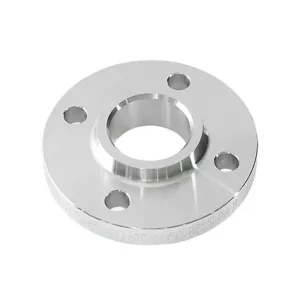
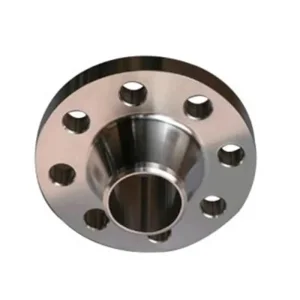
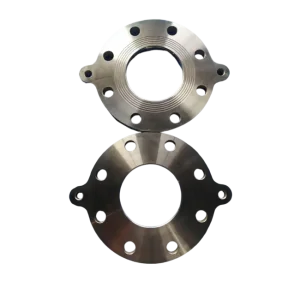
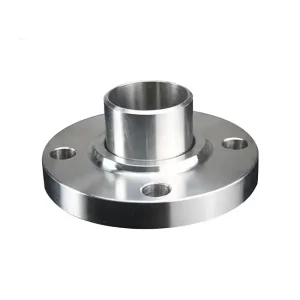
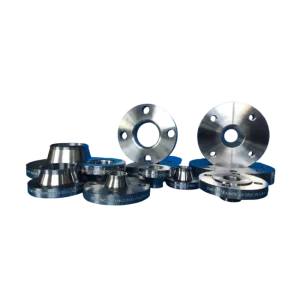
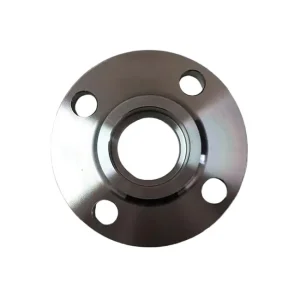
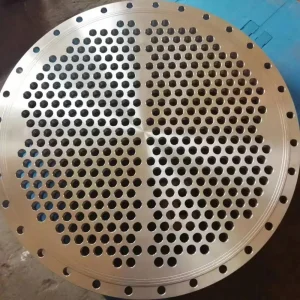
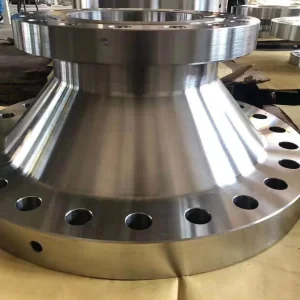
Explore our premier product inventory manufactured to exact ASME, DIN, and EN specifications with complete heat-number traceability.
An authoritative analysis of differential pressure measurement geometry, standard compliance, CNC micro-machining tolerances, and global industrial procurement trends.
Executive Summary for EPC Engineers & Procurement Directors: Orifice flange assemblies serve as the vital sensory apparatus in differential pressure ($\Delta P$) flow measurement. Standard ASME B16.36 and ISO 5167 orifice flanges differ fundamentally from standard ASME B16.5 pipeline flanges by integrating radial pressure tapping holes directly into the flange body, coupled with precision jack-screw alignment features. Achieving precise discharge coefficients ($C$) requires microscopic concentricity, absolute surface roughness compliance ($Ra 3.2 - 6.3\,\mu m$), and zero-burr tapping channels.
In process plants, refineries, cryogenic LNG facilities, and power generation boilers, accurately measuring the volumetric or mass flow rate of fluids (liquids, gases, and steam) is paramount. Differential pressure flow sensing relies on Bernoulli’s principle: as fluid passes through a concentric constriction (the primary element, such as an orifice plate), its kinetic energy increases at the expense of static pressure.
The standard differential pressure equation derived from ISO 5167-2 is given by:
q_m = \frac{C}{\sqrt{1 - \beta^4}} \cdot \frac{\pi}{4} d^2 \cdot \sqrt{2 \cdot \Delta P \cdot \rho_1}
Where qm is mass flow rate, C is the discharge coefficient, β is the ratio of orifice bore diameter to internal pipe diameter (d/D), ΔP is differential pressure, and ρ1 is fluid density upstream. Any dimensional variance in the pressure tapping location directly alters the sensed ΔP, causing systematic flow measurement errors that ripple across billing custody transfer systems and process safety controls.
Selecting the optimal tapping standard and geometry is governed by fluid viscosity, pipe diameter, Reynolds number ($Re$), and line pressure ratings. Shanxi Yuxin Casting & Forging Co., Ltd. manufactures orifice flanges according to four standardized tapping modalities:
Positioned exactly 1 inch (25.4 mm) upstream and 1 inch downstream from the respective orifice plate faces. Standardized in ASME B16.36 across Class 300 to Class 2500. Most prevalent configuration in North American and Middle Eastern petrochemical infrastructures due to modular serviceability.
Pressure taps open directly at the upstream and downstream corners formed by the orifice plate and the flange face. Ideal for small nominal pipe sizes (NPS < 2 inches / DN50) where 1-inch flange tap spacing cannot physically fit between hub fillets.
Upstream tap located at 1 pipe diameter (D) and downstream tap located at 0.5 pipe diameters (D/2) from the plate face. Commonly implemented in large-diameter gas transportation trunklines via custom welded boss connections.
Upstream tap at 2.5 pipe diameters and downstream tap at 8 pipe diameters. Measures total net pressure loss across the orifice metering section. Applied in specialized utility stream monitoring where low dynamic loss recovery is acceptable.
In orifice flange manufacturing, mechanical design directly impacts flow measurement reliability. Standard pipe flanges (ASME B16.5) tolerate minor surface deviations; orifice flanges demand optical-grade micro-finishing and micro-drilling precision:
| Standard Code | Primary Tapping Type | Pressure Ratings | Size Envelope | Facing Types | Key International Markets |
|---|---|---|---|---|---|
| ASME B16.36 | 1-inch Flange Taps (1/2" NPT) | Class 300, 600, 900, 1500, 2500 | NPS 1" to NPS 24" | Raised Face (RF), Ring Type Joint (RTJ) | USA, Middle East, Southeast Asia, South America |
| ISO 5167-2 | Corner Taps / D & D/2 Radius Taps | PN10 to PN400 | DN50 to DN1000 | Form B1 / B2 Raised Face, RTJ | European Union, UK, Central Asia, APAC |
| DIN 1952 / EN 1092-1 | Corner Chamber Taps (Ring-Kammer) | PN16 to PN160 | DN15 to DN600 | Flat Face, Raised Face, Tongue & Groove | Germany, Continental Europe, CIS Region |
| JIS B2220 | Flange Taps / Corner Taps | 10K, 20K, 30K, 63K | 15A to 600A | RF, Male-Female | Japan, Korea, Maritime Shipbuilding Sector |
Rooted in Dingxiang—China’s World-Renowned Hometown of Forging—we combine 33+ years of metallurgical mastery with digital twin CNC automation.
Situated in Shanxi's forging industrial zone, we maintain immediate proximity to premium raw steel mills (Baosteel, TISCO). Direct billet access guarantees 100% material heat traceability from ladle analysis to finished product.
Our 5-axis CNC machining centers execute precision face serrations (125-250 µin AARH smooth or spiral finish) and automated radial tap drilling in a single clamping setup, eliminating angular misalignment errors.
Every orifice flange order ships with full EN 10204 3.1 (or optional 3.2 third-party witnessed) MTC documentation covering UT ultrasonic testing, MT magnetic particle inspection, chemical assay, and Charpy V-notch impact test values.
Navigating the global energy transition, subsea oil gas exploration, and zero-carbon hydrogen flow metering requirements.
The global piping components market is undergoing a structural evolution driven by strict environmental monitoring, high-pressure LNG transport, and hydrogen-blend natural gas pipeline retrofits:
Conditions: 18.5 MPa pressure, 420°C temperature, high H2S hydrogen service.
Solution: Custom ASME B16.36 Weld Neck Orifice Flanges in ASTM A182 F11 Class 2 alloy steel, fitted with RTJ groove facings and 1/2" NPT heavy-wall socket-weld nipples to prevent thermal vibration stress fatigue.
Conditions: Severe marine salt-spray atmosphere, high cyclic hydrodynamic loading.
Solution: Duplex Stainless Steel (UNS S31803 / F51) Orifice Flanges paired with Monel 400 jack screws and fluoropolymer-coated high-tensile bolting to eliminate marine galvanic corrosion.
Conditions: Superheated high-velocity steam metering.
Solution: EN 1092-1 Type 11 Weld Neck Orifice Flanges with integral Corner Chamber (Ring-Kammer) taps in ASTM A105 carbon steel, normalized to deliver long-term fatigue strength.
Direct engineering answers to common inquiries from piping designers, QA auditors, and international procurement managers.
Comprehensive OEM industrial flange solutions forged in-house for seamless pipeline integration.
Send us your engineering drawings, piping specification sheets, or RFQ schedules. Our technical sales engineers respond with complete commercial and metallurgical proposals within 24 hours.