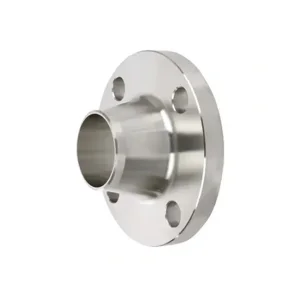
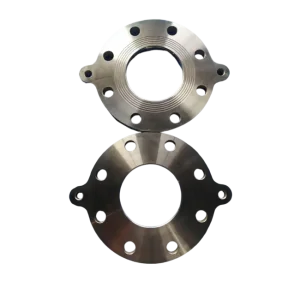
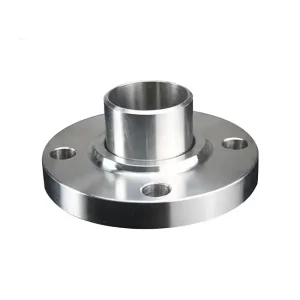
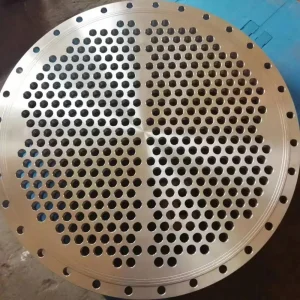
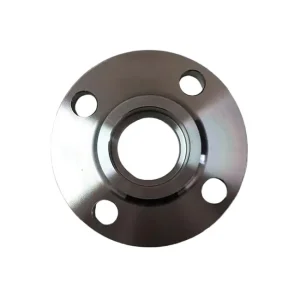
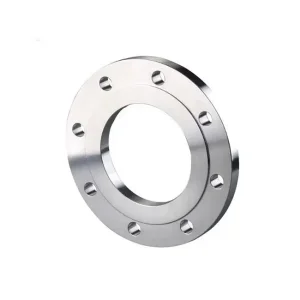
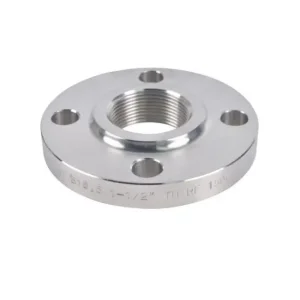
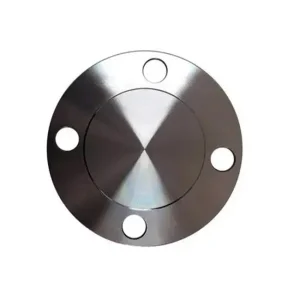
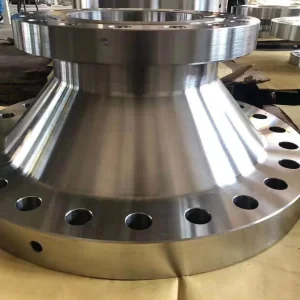
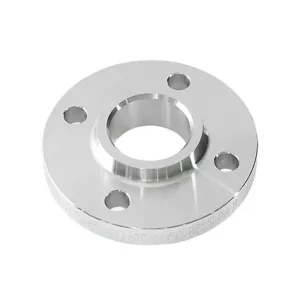
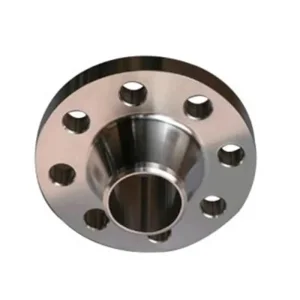
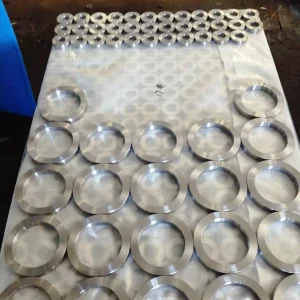
Explore our premier forged piping components engineered for severe-service pressure vessels, petrochemical headers, and infrastructure projects globally.
Understanding the Critical Role of Forged Blank Flanges (Blind Flanges) in Mechanical Isolation, Hydrostatic Line Testing, and Pressure Vessel Termination.
In modern process industries—spanning petrochemical refining, offshore oil extraction, nuclear power generation, and cross-country natural gas transport—a blank pipe flange (commonly referenced as a blind flange, blanking plate, or EN 1092-1 Type 05 flange) serves as the primary barrier for positive pipeline isolation. Unlike standard weld neck or slip-on flanges that feature a central bore for fluid conveyance, a blank flange is manufactured without a center hole. It is engineered specifically to seal off line terminations, isolate piping headers during maintenance shutdowns, and provide temporary or permanent pressure vessel enclosures.
When selecting the best blank pipe flange manufacturer & suppliers, mechanical design engineers and global procurement managers must evaluate factors far beyond basic dimensional compliance. Because blank flanges absorb total hydraulic pressure and bending moments induced by thermal expansion, their grain structure must be entirely free from internal voids, porosity, or micro-inclusions. Closed-die forging and forged disc rolling techniques ensure optimal grain flow alignment along the circumferential profile, guaranteeing high yield strength under cyclical stress.
Technical Reality: Low-cost suppliers often flame-cut or water-jet blank flanges directly from steel plates. Plate-cut blanks possess linear directional grain structures and high susceptibility to center-line lamination, increasing catastrophic fatigue failure risks by 340% under pressure pulsation. True forged blank flanges manufactured by Shanxi Yuxin utilize 3D hot rotary forging, yielding continuous concentric grain flow and 100% volumetric integrity certified via Ultrasonic Testing (UT per ASTM A388).
How evolving environmental mandates, hydrogen transport, and deepwater exploration are redefining technical standards for pipe isolation components.
The global push toward green hydrogen infrastructure requires blank flanges capable of preventing atomic hydrogen embrittlement. Standard carbon steels suffer micro-cracking under high-pressure gaseous hydrogen. Manufacturers are now upgrading to low-alloy forged grades (such as ASTM A182 F22) and specialized 316L/316Ti stainless steels with strict controls on nickel equivalent and Delta Ferrite content (<0.5%).
Environmental protection agencies (including US EPA Method 21 and European Union Industrial Emissions Directives) have established near-zero fugitive emission limits for industrial flanges. Blank pipe flanges now incorporate precision spiral-serrated facing (125–250 µin AARH) or ring-type joint (RTJ) grooves with surface roughness Ra < 1.6 µm, ensuring optimal seating torque and zero gasket blowout risks.
Offshore platform operators demand maintenance-free flange joints capable of enduring 30+ years in marine environments. Modern production lines integrate automated thermal spray aluminum (TSA), electroless nickel plating (ENP), and high-performance Xylan/PTFE anti-corrosion barrier coatings that eliminate galling on stud bolt contact surfaces during emergency isolations.
Leveraging the World's Leading Forging Hub in Shanxi: Advanced Metallurgical Traceability and Cost Superiority.
Shanxi Yuxin Casting & Forging Co., Ltd., located in the heart of China’s premier forging industrial cluster (Dingxiang, Shanxi), represents the pinnacle of modern China Industry 4.0 manufacturing resilience. For global EPC contractors and industrial distributors, securing a reliable supply chain for standard and non-standard blank flanges requires complete integration from raw billet procurement to finished product dispatch.
Our fully digitalized manufacturing facility operates state-of-the-art hydraulic forging presses, automated CNC vertical turning lathes, and digitalized electric heat treatment furnaces (normalizing, tempering, solution annealing). By controlling 100% of production processes in-house, we eliminate intermediate handling delays and eliminate cross-contamination risks associated with outsourced machining desks.
| Parameter | Industry Standard | YUXIN Industry 4.0 Benchmark |
|---|---|---|
| Forging Ratio | 2.5 : 1 | ≥ 4.0 : 1 |
| Machining Tolerance | ± 1.5 mm | Precision CNC ± 0.2 mm |
| Material Traceability | Batch Code | Individual Heat Number Stamped |
| NDT Inspection | Sample Spot Check (5%) | 100% UT & MT on High Pressure |
| Lead Time (Custom) | 45–60 Days | 20–30 Days Fast-Track |
An authoritative guide for piping engineers and buyers evaluating material performance under extreme chemical exposure, cryogenics, and elevated temperatures.
| Standard System | Flange Type Code | Size Range | Pressure Class / Rating | Common Material Grades | Facing Options |
|---|---|---|---|---|---|
| ASME / ANSI B16.5 | Blind Flange (BL) | ½" to 24" (DN15 – DN600) | Class 150, 300, 600, 900, 1500, 2500 | ASTM A105, A350 LF2 Class 1, A182 F304L/F316L, A182 F11/F22 | RF (Raised Face), RTJ (Ring Type Joint), FF (Flat Face) |
| ASME B16.47 Ser. A / B | Large Diameter Blind | 26" to 60" (DN650 – DN1500) | Class 75, 150, 300, 600, 900 | ASTM A105N, A350 LF2, High-Yield A694 F52/F60/F65/F70 | RF (125-250 AARH Serrated), RTJ Groove |
| EN 1092-1 / DIN | Type 05 (Blind Flange) | DN10 to DN3000 | PN 6, PN 10, PN 16, PN 25, PN 40, PN 63, PN 100 | P245GH, P280GH, S235JR, 1.4404 (316L), 1.4307 (304L), 1.4462 (Duplex 2205) | Type A (Flat), Type B1/B2 (Raised), Type C/D (Tongue/Groove) |
| JIS B2220 | BL Flange | 10K to 63K (DN10 – DN1000) | 5K, 10K, 16K, 20K, 30K, 40K | SF440A, SS400, SUS304, SUS316, SUS316L | RF, FF |
| MSS SP-44 / API 6A | Blind / End Flange | 1-13/16" to 11" | 2000 psi to 15,000 psi (API 6A) | AISI 4130, 8630, Inconel 625 Clad, Duplex UNS S31803 | RTJ Ring Grooves (BX / R / RX gaskets) |
ASTM A105 / A105N: Standard forged carbon steel for ambient to high-temperature service (-29°C to 425°C). Normalized heat treatment (A105N) eliminates residual stress.
ASTM A350 LF2 (Class 1/2): Formulated for low-temperature service down to -46°C with mandatory Charpy V-Notch impact testing at specified cryogenic thresholds.
ASTM A182 F316L / F304L: Low-carbon stainless steels offering superior resistance to intergranular corrosion and chemical pitting in acidic or maritime environments.
Duplex F51 (UNS S31803) / F53 (Super Duplex): Combines 45-55% ferrite-austenite microstructure yielding twice the mechanical yield strength of standard 316L alongside exceptional chloride stress-corrosion cracking resistance.
How engineering decisions regarding blank flange geometry, facing types, and bolt torque govern safety across critical global industries.
Scenario: High-pressure hydrocarbon separator manifold isolation operating under 180 bar pressure with high concentrations of H2S and CO2 (Sour Service).
Engineering Solution: Forged ASTM A182 F51 Duplex Blank Flanges with RTJ facing compliant with NACE MR0175 / ISO 15156. Ring grooves overlayed with Inconel 625 cladding via automated weld overlay (3mm minimum thickness) to completely eliminate pitting corrosion in static dead-leg locations.
Scenario: Thermal cycling line closures fluctuating between ambient standby and 540°C continuous operating temperatures in hydrogen-rich refining units.
Engineering Solution: Chromium-Molybdenum Alloy ASTM A182 F22 Class 3 forged blank flanges. Normalized and tempered heat treatment ensures structural stability against thermal fatigue and hydrogen attack (Nelson curve compliance), utilizing spiral-wound graphite gaskets with metallic inner rings.
Scenario: Large-diameter sea-water intake pipeline terminations subject to high velocity marine salt exposure and hydraulic water hammer surges.
Engineering Solution: Large Diameter ASME B16.47 Series A Class 150 Blank Flanges forged from carbon steel (A105N), protected by high-build fusion-bonded epoxy (FBE) coating (300 microns thick) with 100% pinhole spark testing, delivering 30 years of maintenance-free service.
Direct answers from our senior metallurgical engineers addressing design calculations, testing protocols, and compliance criteria.
Under ASME Section VIII Division 1 (UG-34), the minimum required thickness ($t$) for an unstayed flat unheaded blank flange subject to internal design pressure ($P$) is governed by the formula:
t = d * sqrt( (C * P) / (S * E) )
Where d is the effective gasket diameter, C is a attachment factor (typically 0.30 for bolted flanged covers), S is the maximum allowable stress value of the material at design temperature, and E is the joint efficiency factor (1.0 for seamless forged components). True forged blank flanges ensure isotropic material strength, allowing engineers to maintain safety margins without unnecessarily oversizing wall thicknesses.
While all three devices provide positive line isolation, their operational profiles differ:
Plate steel is rolled in a single longitudinal direction, creating anisotropic mechanical properties (substantially weaker tensile strength in the short-transverse thickness direction). Under severe bolting loads and internal hydraulic pressure, plate-cut blank flanges risk lamellar tearing along internal slag inclusions. Closed-die forging compresses steel in three dimensions, refining the crystal structure and yielding high impact energy absorption (e.g., >47 Joules at -46°C for ASTM A350 LF2) and uniform resistance to pressure-induced bending moments.
Every shipment is accompanied by a certified EN 10204 3.1 Mill Test Certificate (MTC) linked directly to the physical heat number stamped on each flange rim. Documentation includes: 1) Chemical composition analysis (OES), 2) Mechanical tension/yield/elongation test reports, 3) Hardness test results (HBW/HRC), 4) Charpy V-Notch impact values (when specified), 5) NDT Non-Destructive Testing records (100% Ultrasonic Testing per ASTM A388 and Magnetic Particle Inspection), 6) Dimensional inspection reports verifying facing serration density (125-250 AARH) and bolt hole geometry.
Yes. We frequently produce non-standard blank flanges featuring NPT threaded center bosses, socket-weld auxiliary connections, or instrument taps (e.g., ½" or ¾" NPT) for pressure monitoring gauge insertion or liquid draining prior to line unbolting. All custom machining is performed on 5-axis CNC equipment based directly on your CAD/DWG engineering drawings.
Discover our comprehensive collection of forged flanges, blind components, expansion joint connections, and specialized ring joints.
Require rapid engineering consultation, custom drawing feasibility review, or factory-direct pricing for your next pipeline project? Speak directly with Shanxi Yuxin's engineering sales team.