+86-350-6071768 [email protected] Dingxiang, Shanxi, China · Forging since 1992
Global Forging Benchmark & Technical Report

Best Black Steel Flange Suppliers & Product

Comprehensive Technical Sourcing Guide, Enterprise Procurement Analysis, and Metallurgical Roadmap for Carbon Steel Piping Systems (ASME B16.5 / EN 1092-1 / DIN)

33+
Years Manufacturing Mastery
10,000
Tons Annual Flange Capacity
40+
Global Export Markets
100%
Heat Traceability (EN 10204 3.1)
Industry Intelligence & Whitepaper

Global Enterprise Procurement Strategy for Black Steel Flanges

In high-pressure fluid transportation, thermal energy conversion, and petrochemical refining systems, selecting the best black steel flange suppliers and products represents a critical capital investment decision. Black steel flanges—referring predominantly to ungalvanized, forged carbon steel flanges treated with black rust-inhibiting paint, black oxide, or bitumen coating—serve as the mechanical backbone for non-corrosive or mildly corrosive heavy-duty fluid lines globally.

As global infrastructure expands across the Middle East, North America, Southeast Asia, and Europe, the demand for high-integrity black carbon steel flanges (conforming to ASTM A105, ASTM A350 LF2, Q235B, S235JR, and P250GH) has surged by over 6.8% year-over-year. Mechanical engineering teams and engineering, procurement, and construction (EPC) conglomerates prioritize zero-defect forged components capable of withstanding severe cyclic thermal stress, hydrostatic pressure spikes, and mechanical fatigue.

Structural Mechanical Integrity

Forged black steel flanges eliminate internal micro-voids, porosity, and inclusions through controlled closed-die and ring-rolling mechanical deformation, ensuring structural safety up to Class 2500 pressure limits.

Superior Thermal Resilience

Engineered for elevated-temperature service (up to +425°C per ASME B16.5 standards), offering continuous dimensional stability, bolt-load retention, and creep resistance under heavy thermal cycling.

Optimal TCO Efficiency

Black steel flanges provide an economical capital cost profile compared to stainless or high-nickel alloys while delivering 30+ year design lifetimes when paired with proper corrosion inhibitors.

Technical Deep-Dive

Metallurgical Standards & Pressure Class Specifications

Understanding carbon steel material grades, heat treatment protocols, and dimensional parameters essential for cross-border engineering compliance.

The performance of a black steel flange depends heavily on the chemical composition of the input billet and the precise heat treatment cycle applied post-forging. Below is an engineering overview of the primary carbon steel grades manufactured by leading global suppliers such as Shanxi Yuxin Casting & Forging Co., Ltd. (established in 1992 in Dingxiang County, Shanxi—the "Hometown of Forging in China").

Material Grade Standard Reference Yield Strength (Min. MPa) Tensile Strength (MPa) Design Temp. Range Primary Industrial Application
ASTM A105 ASME B16.5 / B16.47 250 MPa 485 - 620 MPa -29°C to +425°C Ambient & high-temperature oil, gas, steam piping
ASTM A350 LF2 (Class 1) ASME B16.5 240 MPa 485 - 655 MPa -46°C to +425°C Low-temperature Arctic & cryogenic gas processing
P250GH / S235JR EN 1092-1 Type 01/11 250 MPa 410 - 540 MPa -10°C to +400°C European utility, HVAC, fire fighting & water works
ASTM A182 F11 / F22 ASME B16.5 Low Alloy 275 / 345 MPa 485 / 515 MPa Up to +593°C High-pressure power plant headers & boiler piping

Flange Facing Types & Surface Finish Roughness

To establish a leak-tight mechanical seal under pressure, black steel flanges are machined with standardized facing geometries. The surface roughness of the flange face must match the compression characteristics of the intended gasket material:

  • Raised Face (RF): The most widely specified facing type for Class 150 to Class 900. Features a concentric or spiral serrated finish with a roughness of 125 to 250 µin AARH (3.2 to 6.3 µm Ra) to securely grip spiral-wound or non-metallic gaskets.
  • Flat Face (FF): Specified primarily in cast iron matching or low-pressure carbon steel lines (Class 150) to prevent bending moments during bolt torque application.
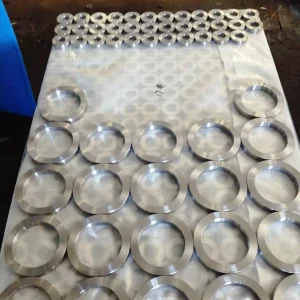
  • Ring Type Joint (RTJ): Engineered for high-pressure Class 600 to Class 2500 service. Incorporates a precision CNC-machined trapezoidal groove to house a metallic ring gasket (Soft Iron or R-series), establishing metal-to-metal sealing up to 10,000 PSI.
  • Tongue & Groove (T&G) / Male & Female (M&F): Matched pairs designed for hazardous or toxic chemical media requiring precise gasket positioning and zero blowout risk.
Manufacturing Precision

The 7-Stage Forging & Machining Roadmap

How premier Chinese manufacturers maintain zero-defect standards across 10,000+ metric tons of annual production.

Stage 01

Billet Cutting & Inspection

Certified steel round bars are saw-cut to weight precision. Spectro-chemical PMI testing verifies material heat chemistry before heating.

Stage 02

Induction Heating & Forging

Billets are heated to 1150°C. High-tonnage hydraulic presses and ring-rolling mills align metal grain flow along stress contours.

Stage 03

Normalizing Heat Treatment

Flanges undergo normalizing at 880°C–920°C followed by controlled air cooling, refining grain microstructures for impact toughness.

Stage 04

CNC Precision Machining

Multi-axis CNC lathes machine the bore, flange thickness, outer diameter, bolt circle, and facing serrations to sub-millimeter tolerances.

Sourcing & Procurement Guidelines

How to Evaluate & Select the Best Black Steel Flange Suppliers

Strategic audit criteria for procurement officers, EPC buyers, and industrial stockists sourcing high-volume forged steel components.

Navigating the global supply market for carbon steel pipe flanges requires balancing cost per unit against long-term risk management. Buying directly from integrated forging mills—such as Shanxi Yuxin Casting & Forging Co., Ltd.—offers structural advantages over dealing with trading intermediaries:

1. Quality Management & International Accreditation

A reputable supplier must maintain a verified quality management system backed by tier-one international registrars. Crucial credentials include:

  • ISO 9001:2015 Management System Certification: Audited by TÜV CERT or equivalent global notification bodies.
  • PED 2014/68/EU (Pressure Equipment Directive): Mandatory for supplying flange components into European Union pressure piping installations.
  • AD 2000-Merkblatt W0 / TRD 100: Ensures compliance with German safety standards for pressure-retaining forged materials.
  • EN 10204 3.1 / 3.2 Material Traceability: Every shipment must include original Mill Test Reports (MTR) detailing chemical analysis, heat treatment history, tensile/yield strengths, and impact values tied to the physical heat number stamped on the flange rim.

2. Advanced Non-Destructive Testing (NDT) Protocol

Top-tier suppliers utilize rigorous non-destructive evaluation to catch internal defects prior to dispatch. Standard testing procedures include:

Ultrasonic Testing (UT)

Detects internal subsurface cracks, laminations, and density inconsistencies per ASTM A388 standards across critical stress sections.

Magnetic Particle (MT)

Identifies surface and immediate near-surface discontinuities along weld bevels and radius junctions using magnetic field leakage.

Positive Material ID (PMI)

X-ray fluorescence (XRF) alloy verification guarantees zero material mix-ups across carbon, alloy, and stainless inventory.

Industrial Applications

Macro-Industry Solutions & Application Scenarios

Where forged black steel flanges deliver uncompromising reliability in mission-critical infrastructure worldwide.

Black carbon steel flanges are utilized extensively across heavy industries where mechanical stress, fluid pressure, and temperature fluctuate continuously. Key sectors include:

1. Oilfield & Natural Gas Pipeline Networks

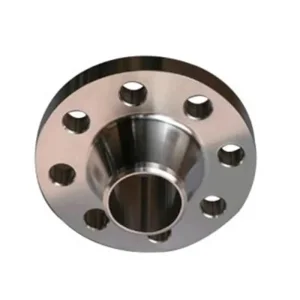
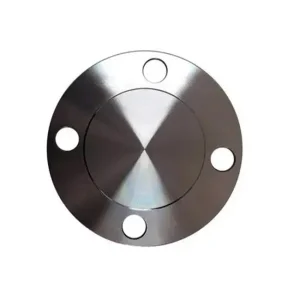
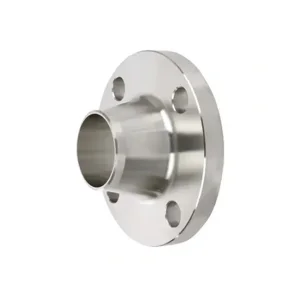
High-pressure midstream and upstream pipelines utilize ASME B16.5 Weld Neck (WN) and Blind (BL) black steel flanges (Class 600 to Class 2500). For sour crude oil applications containing hydrogen sulfide ($H_2S$), flanges are supplied in NACE MR0175 / ISO 15156 compliant ASTM A105N condition, ensuring resistance to sulfide stress cracking (SSC).

2. Thermal Power Generation & District Heating

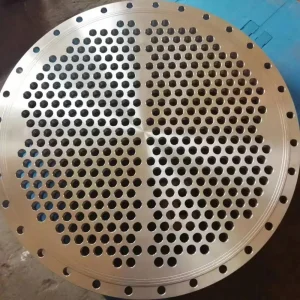
High-temperature steam distribution lines and boiler feedwater circuits require heavy-wall forged black steel flanges capable of surviving constant thermal expansion and contraction. Matching tube sheets and custom rings manufactured per TEMA standards ensure leak-free operation inside shell-and-tube heat exchangers.

3. Chemical Refineries & Heavy Process Equipment

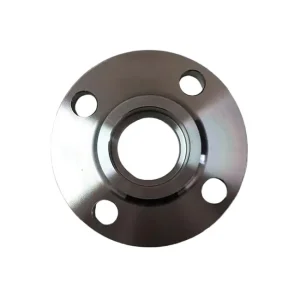
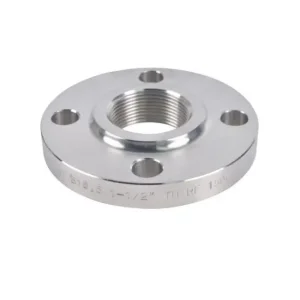
Refinery installations rely on Slip-On (SO), Socket Weld (SW), and Threaded black steel flanges to connect heat exchangers, pressure vessels, and pumps. Black anti-corrosion varnish or zinc-rich primer coatings protect external surfaces during storage and plant erection.

4. Water Distribution, HVAC & Fire Protection Systems

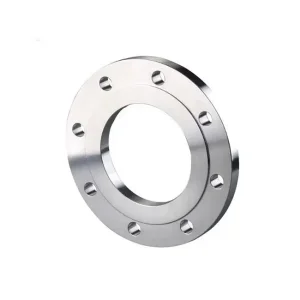
For municipal water mains, HVAC cooling towers, and industrial fire sprinkler headers, cost-efficient EN 1092-1 Type 01 Plain/Plate flanges and ASME Class 150 Slip-On flanges provide rapid alignment, lower overall installation costs, and long-term durability.

Future Outlook

Technology Roadmap & Sustainable Forging Innovation

Advancing Industry 4.0 automation, green steel sourcing, and eco-friendly protective coatings in flange manufacturing.

The steel forging sector is undergoing a profound transformation driven by digital quality control and global decarbonization commitments. Forward-thinking manufacturers are leading this evolution through three main technological pillars:

  • AI-Powered Dimensional Inspection: Automated 3D optical scanning arms and laser coordinate measuring machines (CMM) conduct 100% full-geometry verification on critical flange faces, bolt circle diameters (BCD), and hub bevels, eliminating human error in complex OEM custom forgings.
  • Green Steel & Carbon Footprint Reduction: Transitioning furnace operations to energy-efficient natural gas and induction heating systems, coupled with recycled scrap steel utilization in electric arc furnaces (EAF), significantly reduces Scope 1 and Scope 2 carbon emissions per ton of finished flange output.
  • Eco-Friendly Black Anti-Corrosion Coatings: Migration away from traditional solvent-based bitumen paints toward zero-VOC waterborne acrylic coatings, electro-deposited black oxide, and bio-based protective wax coatings that comply with EU REACH and RoHS environmental standards.
Knowledge Center

Frequently Asked Questions (FAQ)

Expert technical answers to common queries regarding black steel flange selection, standards, logistics, and quality assurance.

What is the difference between a Black Steel Flange and a Galvanized Carbon Steel Flange? ↓
A black steel flange features a raw forged carbon steel surface treated with black rust-inhibiting paint, black oxide, or oil coating to prevent surface oxidation during transit and indoor storage. It is ideal for welding directly into piping systems without needing zinc stripping. A galvanized carbon steel flange is hot-dip coated in molten zinc, offering superior atmospheric corrosion protection for exposed outdoor or marine environments, but requires edge preparation prior to welding to avoid zinc embrittlement and toxic fumes.
Which pressure ratings and standards can Shanxi Yuxin Casting & Forging supply? ↓
YUXIN manufactures forged black steel flanges conforming to ASME B16.5, ASME B16.47 (Series A & B), EN 1092-1, DIN, JIS, GOST, and BS standards. Pressure classes range from Class 150 to Class 2500 under ASME and PN6 to PN400 under EN/DIN standards. Sizes range from 1/2" (DN15) up to 120" (DN3000), with custom ring rolling up to 3,000 mm outer diameter.
Why is ASTM A105 the standard material choice for black forged steel flanges? ↓
ASTM A105 is the industry-standard carbon steel material specification for forged piping components operating in ambient and elevated temperature service. It provides an optimal balance of high yield strength (≥ 250 MPa), excellent weldability, superior machinability, and cost efficiency. When normalized, ASTM A105 exhibits excellent notch toughness suitable for pressure piping per ASME B31.1 and B31.3.
What documentation accompanies a batch of forged black steel flanges upon shipment? ↓
Every shipment includes a comprehensive document package: original EN 10204 3.1 Mill Test Certificate (MTC) detailing steel heat numbers, chemical composition (C, Mn, Si, P, S, Cr, Ni, Mo, Cu, V), mechanical test results (tensile, yield, elongation, hardness, impact testing), heat treatment charts, dimensional inspection reports, NDT non-destructive examination logs, Commercial Invoice, Packing List, and Certificate of Origin (CO). Third-party inspection (TPI) per EN 10204 3.2 by SGS, BV, or TÜV is available upon request.
How are black steel flanges protected against damage during ocean freight transit? ↓
All flange raised faces and weld bevels are treated with rust-preventive black varnish or grease and covered with plastic protective end caps. Flanges are securely strapped on fumigation-free ISPM-15 compliant plywood pallets or packed inside heavy-duty seaworthy wooden crates lined with waterproof plastic sheeting, ensuring full protection against saltwater mist, humid air, and mechanical impact during multi-week ocean shipments.
What is the typical production lead time and Minimum Order Quantity (MOQ)? ↓
Standard size carbon steel flanges in stock semi-finished condition ship within 7 to 15 days following CNC final machining. Custom forged-to-order flanges, non-standard tube sheets, or large-diameter EN 1092-1 flanges typically require 20 to 35 days depending on material availability and forging die setup. Flexible MOQ terms are offered to accommodate trial project orders, distributor stock replenishment, and urgent repair schedules.
Can YUXIN produce non-standard or custom-machined flanges based on customer drawings? ↓
Yes. Our in-house tooling shop and engineering department specialize in custom forgings based on customer CAD/DWG drawings, PDF schematics, or sample parts. We produce custom-bore weld neck flanges, oversized tube sheets, heavy ring flanges, and specialized expansion joint flanges up to 3,000 mm diameter with customized bolt patterns, cladding, and surface treatments.